
Cost Allocation
Department and service-line cost allocation that runs in minutes, not overnight, with drivers finance can explain.
Learn More →Cost allocation in minutes. Service-line reporting finance trusts.
CloudADDIE builds Oracle EPM for healthcare finance: department and service-line cost allocation, Epic and EHR data integration, regulatory and variance reporting, and FP&A models for the CFO team, typically in 12 to 24 weeks.
Department and service-line cost allocation that runs in minutes, not overnight, with drivers finance can explain.
Learn More →
Reporting that ties operational volumes from Epic to financial results, produced from one governed source.

Validated data integration between Epic, your ERP, and Oracle EPM so cost and service-line reports tie back to every system.
Learn More →
FP&A models for the CFO team that reflect volumes, payer mix, and staffing.

Fixes for slow planning applications. In one engagement, report runtimes went from 2 to 3 hours to under 30 seconds.
Learn More →
See the healthcare EPM price range on the Product-Specific Scoping page.
Learn More →Healthcare finance needs more than general Planning experience. CloudADDIE has delivered cost allocation, service-line reporting, and EHR-connected planning for health systems.
Epic holds the operational truth, the ERP is the financial system of record, and Oracle EPM handles planning, allocation, and reporting. The work is in the integrations and validation between them.

A connected finance architecture for healthcare: Epic for operational truth, NetSuite for the financial system of record, Oracle EPM for planning. Governed, integrated, and built for CFO-grade decisions.

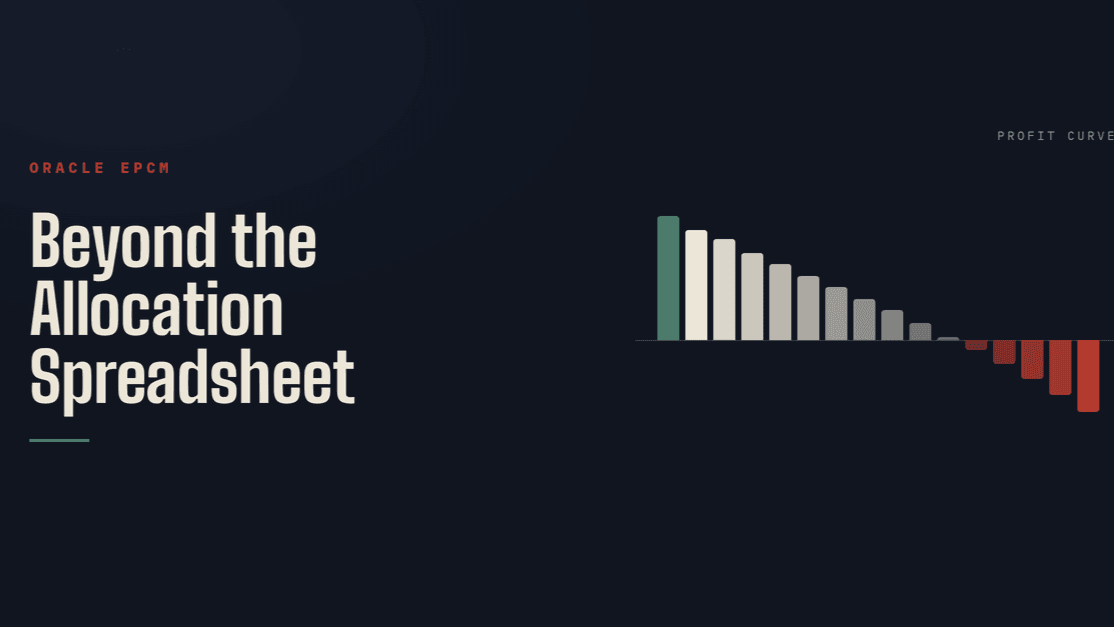
What Oracle EPCM actually is, why spreadsheet allocation models eventually break, the two questions every allocation model has to answer, and how implementations typically take shape.
Why the dimensional model, not the allocation rules, decides how flexible an Oracle EPCM application will be for the next five years, and the three things worth checking in every design review.
CloudADDIE publishes its healthcare EPM price range on the Product-Specific Scoping page. Projects typically take 12 to 24 weeks and cover department and service-line cost allocation, Epic or EHR data integration, regulatory and variance reporting, and FP&A model design.
Yes. A common architecture uses Epic as the operational source, the ERP as the financial system of record, and Oracle EPM for planning, allocation, and reporting. CloudADDIE builds and validates the data integration between them so service-line and cost reports tie back to both systems. Read Connected Healthcare Finance.
Move allocation logic out of legacy scripts and spreadsheets into a purpose-built model, with clean drivers and fewer manual handoffs. In one CloudADDIE engagement, a Fortune 500 health network cut cost allocation from over three hours to 45 minutes.
Plan for 90 to 120 days of procurement in most health systems, on top of the 12 to 24 week delivery timeline. Starting with a fixed-fee assessment gives procurement a defined scope, timeline, and price to approve.
Look for consultants with healthcare-specific delivery: cost allocation, service-line profitability, and EHR integration, not just general Planning experience. CloudADDIE has healthcare case studies in cost allocation modernization and report performance remediation.