
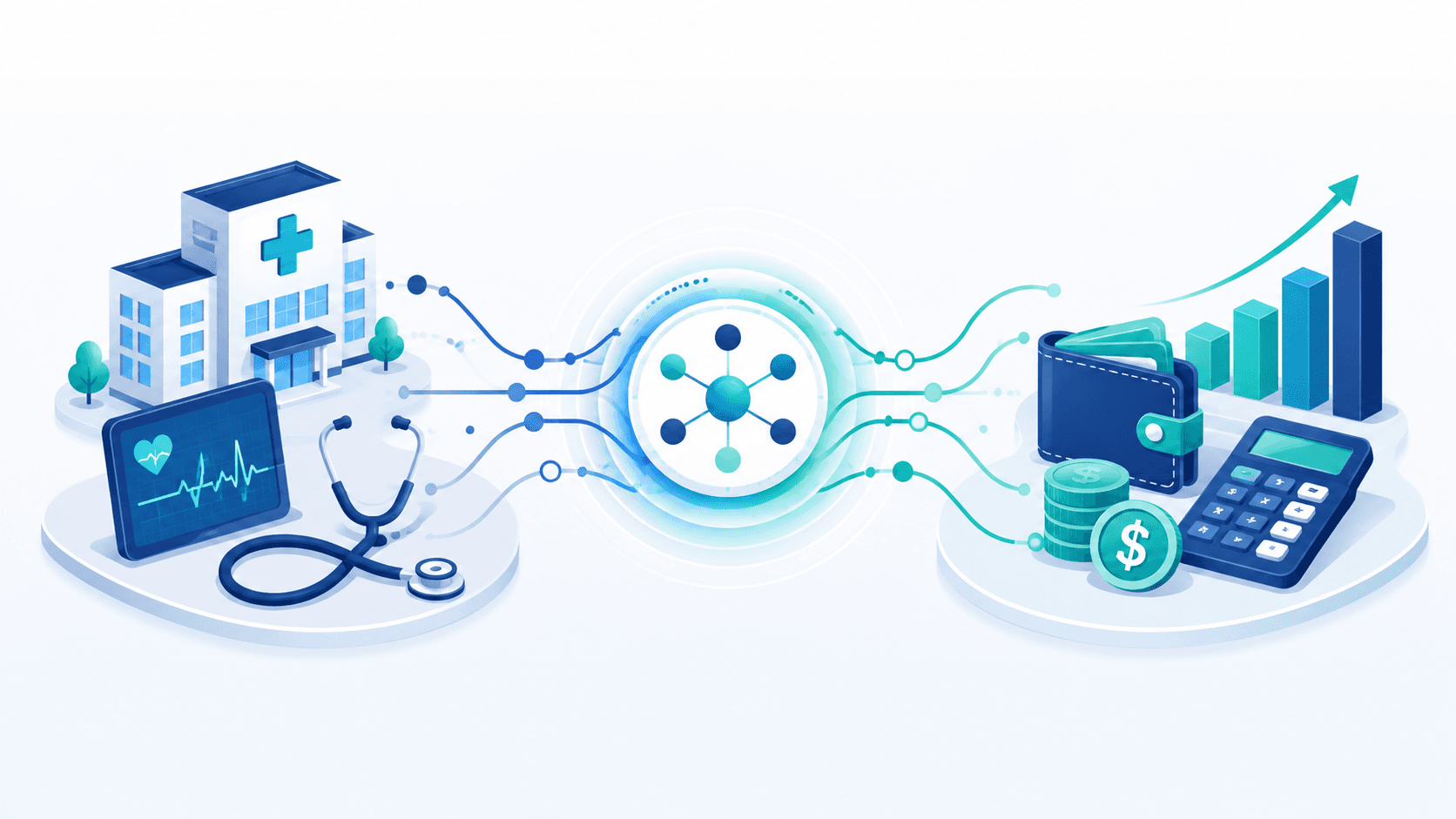
Healthcare systems are drowning in disconnected data.
Healthcare CFOs are being asked to do something their systems were never designed to support: make fast, forward-looking decisions in an environment where clinical activity, operations, and finance exist in separate worlds.
Patient volumes shift weekly. Labor costs fluctuate with overtime and contract staffing. Payer mix moves margins overnight.
Yet the data that explains these changes often reaches finance too late to influence planning decisions.
Manual forecasting slows agility and creates inconsistent assumptions across teams. Spreadsheets can't keep up with the complexity of healthcare operations. Dashboards show what happened, but not why or what to do about it.
The result is predictable: reactive decision-making, missed opportunities, and finance teams spending more time reconciling data than shaping strategy.
The fix isn't another report. It's a connected finance architecture, one that links operational truth in Epic to planning truth in your ERP and EPM platforms, so leaders see what's happening while they can still act on it.
Epic holds operational truth. Finance needs planning truth.
Most healthcare organizations still rely on a fragmented reporting process. Epic EMR captures operational activity, manual extracts move the data, spreadsheets handle modeling and adjustments, and finance reports are produced, usually too late to influence decisions. Each handoff introduces friction, reconciliation effort, and reporting delays. The consequences are predictable:
- Limited scenario modeling
- Inconsistent KPIs across departments and facilities
- Delayed visibility into operational performance.
The gap isn't in Epic or finance itself. It's in the layer between them, where operational signals should be transformed into planning intelligence but instead become trapped in spreadsheets.

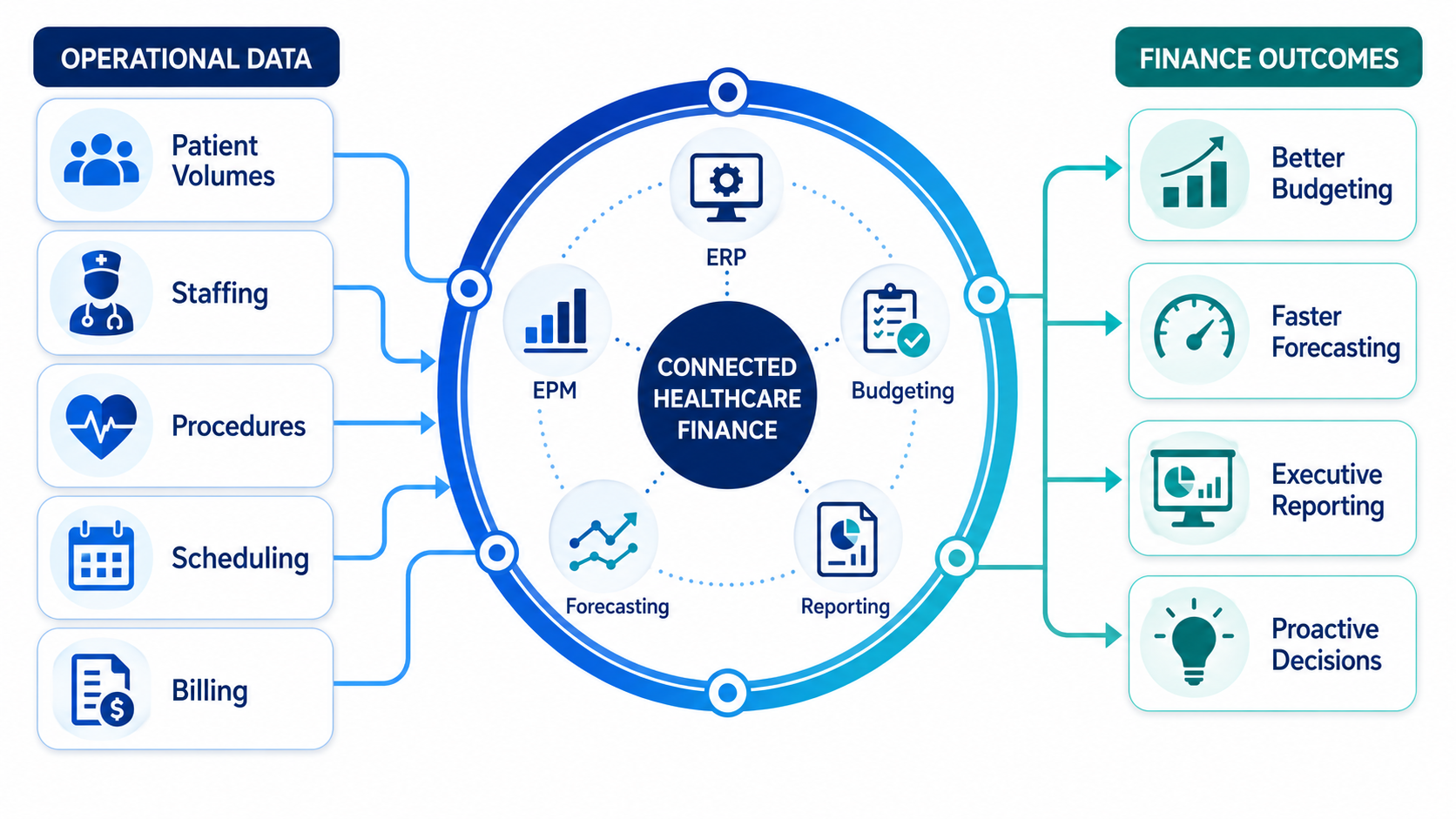
A connected healthcare finance architecture.
Connected systems create faster, smarter healthcare decision-making.

The data layer is the enabler, the real outcome is connected finance visibility and better planning decisions, not another integration project.
Turning operational data into planning intelligence.
Healthcare finance requires more than reporting.
A connected platform supports four interlocking capabilities:
- Budgeting and rolling forecasts that tie actual activity to forward-looking plans
- Workforce and labor planning that models staffing demand, overtime and productivity
- Scenario modeling that lets leaders evaluate volume shifts and payer mix changes before they commit
- Service line profitability that translates operational activity into margin insight.
These aren't separate projects. They are outputs of the same connected foundation.
Where NetSuite fits.
NetSuite can serve as the financial system of record for healthcare finance operations. It handles:
- General ledger and financial close
- Department, class, location and segment reporting
- AP, purchasing and expense visibility
- Actuals foundation for budgeting and forecasting
When the GL is clean and the segments are well-designed, every downstream planning model gets stronger.
Where NSPB and Oracle EPM fit.
Planning tools turn ERP actuals and operational drivers into forward-looking decisions.
NetSuite Planning and Budgeting (NSPB) and Oracle EPM can handle:
- Budgeting and forecasting
- Driver-based planning
- What-if and scenario analysis
- Management reporting
- Multi-department planning alignment.
The pattern is consistent: operational drivers combined with ERP actuals feed planning models, which inform executive decisions.
High-value Healthcare Planning Use Cases.
When operational activity drives proactive financial planning, the use cases write themselves:
- Patient volume forecasting
- Labor and staffing projections
- Payer mix impact analysis
- Procedure volume planning
- Supplies and drug cost forecasting
- Service line profitability
Each of these is difficult to execute well in a spreadsheet. Each becomes routine in a connected platform.
Labor is the largest healthcare expense.
For most health systems, labor is the single biggest line on the P&L and the one most exposed to operational variability.
Connected planning improves staffing visibility and forecasting accuracy across nursing and staffing projections, overtime and contract labor analysis, budget vs actual labor cost tracking, workforce scenario planning, and productivity and utilization insights.
If you can only fix one thing this year, fix this. The ROI shows up fast.
Integration should support decisions, not create complexity.
The point of integration isn't to move data for its own sake. The goal is trusted data, governance, and scalable reporting.
That comes down to three disciplines:
- Secure movement, which means moving only the data needed for finance planning and reporting.
- Governance, which means standardizing mappings, dimensions and definitions.
- Scalable reporting, which means building repeatable pipelines that reduce manual reconciliation.
Do these three well and the platform gets easier to use over time, not harder.
Better operational visibility leads to better financial decisions.
Connected healthcare finance creates agility, visibility, and confidence.
Faster planning cycles, improved workforce visibility, better operational forecasting, stronger executive reporting, and connected decision-making across the organization.
The organizations pulling ahead aren't the ones with more dashboards. They're the ones whose finance teams see operational reality early enough to shape it.
CloudADDIE places great importance on connecting healthcare operations to finance.
Most health systems already have Epic capturing operational activity and an ERP closing the books.
What's missing is the connected layer in between that turns operational signal into planning intelligence.
Connected healthcare finance links Epic EMR to NetSuite ERP, NSPB or Oracle EPM, and executive reporting so CFOs gain faster planning cycles, improved workforce visibility, better operational forecasting, stronger executive reporting, and connected decision-making across the organization.