
There has been a steady stream of AI announcements around Oracle EPM this year, and most of the commentary I see falls into one of two camps.
Either it treats the whole thing as a single feature that appeared one morning, or it stays at a level of abstraction that never touches what an implementation team would actually have to do.
Neither is very useful if you are the person who has to scope the work.
So here is a practitioner's read on Oracle's EPM Assistants for AI Agent Studio: what has actually been released, what you get when you import it, how the architecture holds together, and the prerequisite that will decide whether any of this is available to you at all.
First, the Release Naming
A small thing that causes a surprising amount of confusion.
Oracle Fusion Cloud EPM runs on monthly updates, named in YY.MM format. The August 2026 update is 26.08.
The quarterly 26A, 26B, 26C naming belongs to Fusion Applications, not to EPM Cloud.
That matters here because the EPM Assistants did not arrive in one drop. They have been landing progressively across the monthly updates, and knowing which update introduced what is the difference between planning against reality and planning against a headline.
What Shipped, and When
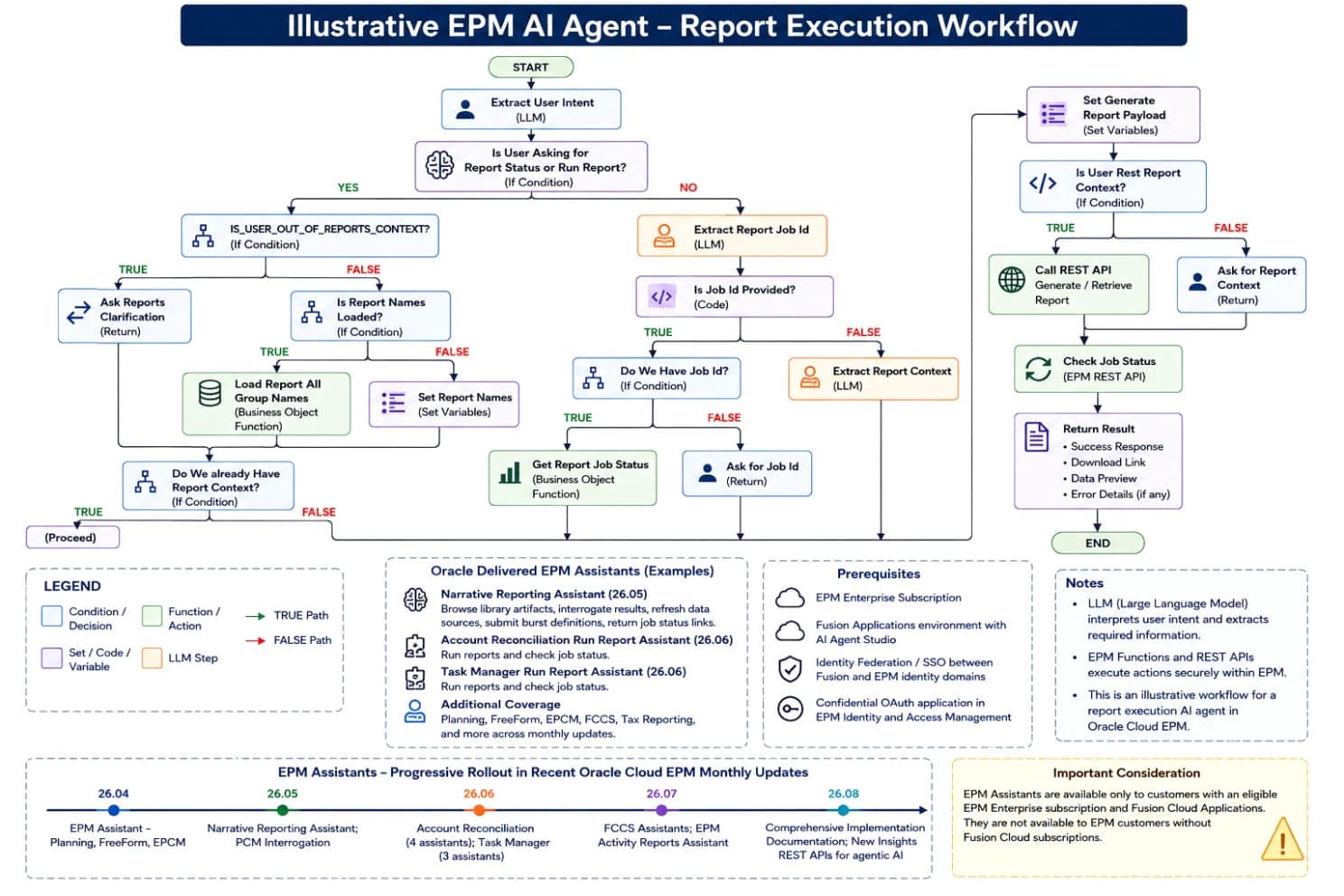
26.04. The first EPM Assistant package, covering Planning, Freeform and Enterprise Profitability and Cost Management. Preconfigured JSON definitions you import into AI Agent Studio.
26.05. The Narrative Reporting Assistant, plus the PCM Interrogation Assistant for EPCM.
26.06. Account Reconciliation gets four assistants: Transaction Matching for administrators, Account Reconciliation for administrators, Account Reconciliation for users, and a Run Report assistant for users. Task Manager gets three: a user assistant, an administrator assistant, and a Run Report assistant.
26.07. Financial Consolidation and Close arrives with two administrator assistants, one for creating Configurable Consolidation rules and one for consolidation performance diagnostics. The EPM Activity Reports Assistant also appears across several business processes.
26.08. No new assistant families, but two things worth noting. Oracle published comprehensive implementation documentation for EPM Assistants in AI Agent Studio, which was the missing piece for anyone trying to plan this properly. And new REST APIs for Insights opened up further agentic interaction.
Across the Features with AI documentation, the business processes now covered are Planning, FreeForm, EPCM, Narrative Reporting, Tax Reporting, Account Reconciliation and Financial Consolidation and Close, with Task Manager assistants layered across several of them.
What You Actually Get on Import
This is where I think the value sits, and it is easy to undersell.
The assistants are downloadable JSON artifacts. When you import one into AI Agent Studio, it creates agent teams, agents, tools, business objects and business object functions, already wired to the relevant Cloud EPM REST APIs.
These are implementation accelerators rather than turnkey solutions, and I think that is an honest description rather than a hedge.
If you have built an agent workflow against EPM from scratch, you know where the time goes. Very little of it is the clever part. It is defining the flow, describing every tool precisely enough for a model to select it correctly, mapping REST payloads, handling OAuth, deciding what happens when a user gives you half the context you need, and then handling the twenty variations of how someone might phrase a request.
Starting from a working set of artifacts removes a meaningful slice of that and lets the conversation move to the finance process much earlier.
What It Looks Like in Practice
Reporting is the easiest example to picture, and it is worth being precise about which assistant does what, because this is where a lot of the commentary gets loose.
Today, a user who wants a report navigates to it, sets the point of view, submits it, then goes and checks the job to see whether it finished. Four or five context switches for something they do every month.
The Narrative Reporting Assistant, released in 26.05, changes the shape of that.
A user can browse Library artifacts (Reports, Report Packages, Bursting Definitions) through conversation, interrogate the results of a selected report, refresh Report Package data sources as a scheduled job, and submit Bursting Definitions as Job Scheduler jobs, with the job link returned in the chat so they can follow it.
Account Reconciliation and Task Manager both have their own Run Report assistants for users. Job status checking is documented for the Account Reconciliation and Transaction Matching administrator assistants.
Note what is not in that list. No Planning assistant is documented as running a Planning report and polling its job status. If you are building a business case around that specific flow, you are building it, not importing it.
The Architecture Point
The reason this design works is the separation of responsibility, and it is worth stating plainly for anyone being asked whether an LLM is now running the close.
The language model handles the conversation. It interprets intent, works out which tool applies, notices when required context is missing, and asks for it. That is all it does.
The EPM side handles everything that matters. Business objects and business object functions define what can be called. REST APIs execute it. The application does the actual work.
And security is not routed around at any point. The agent operates under a configured identity, established through federation between the Fusion Applications and Cloud EPM identity domains and a confidential OAuth application in EPM IAM. EPM roles and data grants still determine what comes back. A user who cannot see an entity today does not get to see it because they asked an agent instead. That is the answer to the first question your security team will raise, and it is a good answer.
The Prerequisite That Decides Everything
Here is the part I would put in front of any steering committee before the first enthusiastic slide.
EPM Assistants require an EPM Enterprise subscription of Cloud EPM or Cloud EDM, and a Fusion Applications environment with AI Agent Studio for Fusion Cloud Applications. Oracle states directly that these are available only to Fusion customers and are not available to EPM customers without a Fusion Cloud subscription.
On top of that, the setup involves assigning the Service Administrator role in Cloud EPM, configuring federation between the two identity domains, creating a confidential application in EPM IAM, establishing a data source connection in AI Agent Studio, and then importing the artifacts.
If you are running standalone EPM with no Fusion footprint, none of this is available to you yet. That is a licensing and landscape conversation, not a technical one, and it is far better had in week one than in week six.
Where I Would Start
If the prerequisites clear, I would not begin with the most visible process. I would begin with the one that is repetitive, low judgement and high volume, where a wrong answer is obvious and cheap to correct. Report retrieval and status checking fits. Reconciliation status queries fit. Task Manager commentary and assignment lookups fit.
The processes I would not hand to an agent first are the ones where the value is in the judgement rather than the navigation.
Which reframes the question I keep hearing. It is not where can we use AI in EPM. Almost anywhere, eventually. It is which repetitive finance processes are worth redesigning around agents first, and what has to be true about our licensing, identity and security posture before we can start.
That second half is where most programmes will actually be decided.