

Note: This article was originally published in 2019 and updated in February 2026 to reflect current product naming, Oracle's current licensing model, and current labor-cost benchmarks. The figures below are illustrative; your own numbers will depend on your team, your scope, and your negotiated Oracle pricing.
For decades, the monthly account reconciliation was a manual exercise. Analysts pulled balances into workbook after workbook, tied general ledger figures to sub-ledgers and bank statements by hand, chased down variances, and stitched the evidence together across a sprawl of tabs and files. At many organizations the close still runs this way, and it still consumes three to five business days of skilled analyst time every single month, longer at larger or more complex companies.
Oracle Account Reconciliation, part of Oracle Fusion Cloud EPM and still widely known by its former name, Account Reconciliation Cloud Service (ARCS), was built to replace that grind. Instead of manually preparing every reconciliation, teams configure rules that automatically reconcile low-risk accounts, match high volumes of transactions, and route only the exceptions to a person. The result is not a modest efficiency gain; it is a structural change in how much human effort the close requires, and where that effort is spent. The question in the title is worth asking honestly: if you are still reconciling in Excel, what is it actually costing you?
The Hidden Cost of Reconciling in Excel
Excel is inexpensive, familiar, and genuinely good at ad hoc analysis, which is exactly why it became the default reconciliation tool. But for a recurring, controls-heavy process like the monthly close, its cost is not in the license; it is in everything that surrounds the spreadsheet. Manual reconciliation is labor-intensive, and skilled analyst time is the most expensive input in the process. It is also error-prone, because formulas break, links go stale, and a single mis-keyed cell can flow silently into the financials. And it is difficult to control, since spreadsheets offer little in the way of enforced workflow, segregation of duties, audit trail, or real-time visibility for a controller who needs to know where the close stands right now.
To make the comparison concrete, we can put a defensible dollar figure on the labor. According to the U.S. Bureau of Labor Statistics, the median wage for financial analysts was $101,350 per year, or about $48.73 per hour, as of May 2024. Using that median as a transparent, single labor rate throughout, a team reconciling for four business days a month spends roughly:
- 4 days x 8 hours x $48.73 per hour = $1,559.36 per analyst, per month of pure reconciliation labor
That figure is deliberately conservative. It counts only base wage, not the fully-loaded cost of an employee (benefits, payroll taxes, and overhead typically add 25 to 40 percent or more), and it counts only the reconciliation days themselves, not the review, rework, and error-correction that manual processes tend to generate.
The Analysis: Excel vs. Oracle Account Reconciliation
Automation changes the labor equation. With auto-reconciliation rules and transaction matching handling the routine volume, the recurring human effort drops to periodic maintenance, exception handling, and review, rather than preparing every reconciliation from scratch. In our implementations, that ongoing effort commonly lands around six hours per analyst per month. Against that saving you have to weigh the software subscription and the one-time implementation.
A word on pricing, because it has changed significantly since this article first ran. Oracle Account Reconciliation is no longer sold as a standalone flat rate. It is licensed within Oracle Fusion Cloud EPM on a per-hosted-named-user, per-month basis, and it is included in the EPM Standard edition, which lists in the range of about $250 per user per month with a minimum user commitment. Published references put the reconciliation capability itself in roughly the $150 to $250 per user, per month range at list, with negotiated rates in practice often falling well below that. Oracle EPM is one of the more heavily discounted cloud suites, so treat any list figure as a starting point and confirm your own number with a current quote.
For this illustration we use a representative $175 per user, per month license and the BLS median labor rate above. On that basis, the monthly cost per analyst looks like this:
- Excel (manual): roughly $1,559.36 per analyst, per month in reconciliation labor
- Oracle Account Reconciliation: about 6 hours of maintenance (6 x $48.73 = $292.38) plus the $175 subscription = $467.38 per analyst, per month
- Recurring saving: approximately $1,091.98 per analyst, per month
The subscription is not free, and neither is the implementation, which for a tightly-scoped, single-module rollout commonly runs on the order of $25,000, and more for complex, multi-source environments. But the recurring labor saving is large enough that the investment is recovered quickly, as the break-even below shows.
Break-Even Analysis
Consider a mid-size company running the process with two analysts. Its manual reconciliation labor runs about $3,119 per month, while the automated equivalent, subscription included, runs about $935 per month, for a recurring saving of roughly $2,184 per month. Set the one-time implementation at $25,000, and the two cost curves cross before the end of the first year.
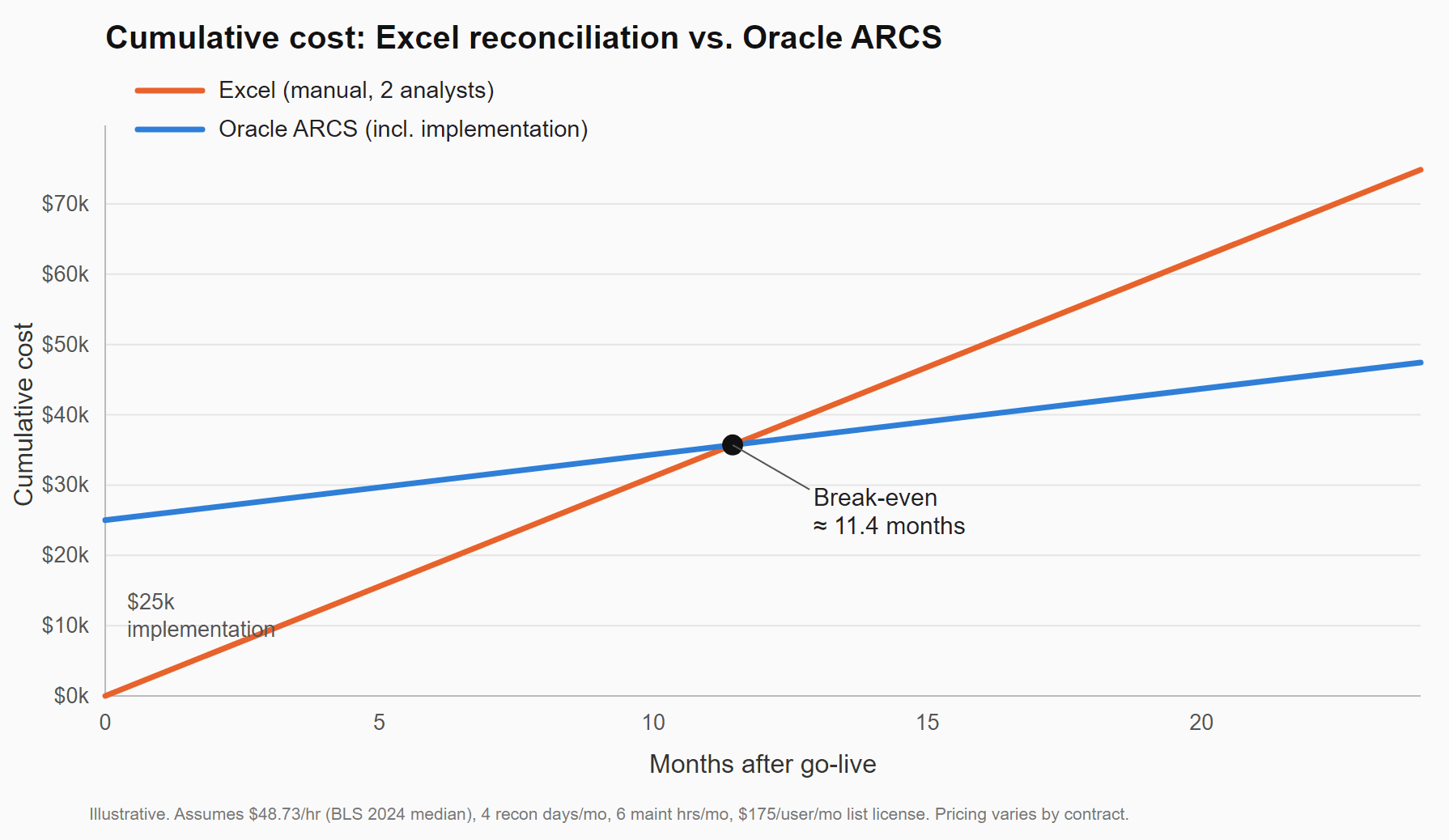
In this scenario the investment reaches break-even at about 11 to 12 months, and the first year is already net positive by roughly $1,210 after absorbing the full implementation cost. From year two onward, with the one-time cost behind you, the saving compounds; over three years the same assumptions produce net savings on the order of $53,600 for a two-analyst team.
Two things are worth stressing about this model. First, it is sensitive to its inputs: a lower negotiated license or a fully-loaded labor rate pulls break-even sooner, while a larger implementation scope pushes it later. Second, and more importantly, cost is only the most quantifiable benefit. The stronger case for automating reconciliation is usually about risk and control, not payroll.
Beyond Cost: Accuracy, Security, and Visibility
Accuracy. Removing manual preparation removes the most common source of reconciliation error. Auto-reconciliation rules apply the same logic every period, transaction matching compares large populations without human transcription, and variance thresholds flag anything outside tolerance. Analysts spend their time investigating genuine exceptions instead of re-checking arithmetic.
Security and control. Access is governed by role, so preparers, reviewers, and administrators see and do only what their responsibilities require. Enforced preparer-and-reviewer workflow builds segregation of duties into the process rather than relying on convention, and every action is captured in an audit trail, which is exactly the kind of evidence external auditors expect and spreadsheets cannot produce.
Visibility. Dashboards and pre-built reports show the real-time status of the close at a glance: what is complete, what is outstanding, what is overdue, and where the risk sits by account. A controller no longer has to email around asking who has finished what.
Together these translate into faster closes, cleaner audits, and a reconciliation process that scales with the business instead of straining against it, benefits that persist long after the initial payback period.
Case Study: Construction and Infrastructure
A construction and infrastructure client needed their general ledger and sub-ledger to reconcile at the group level, a process that had been consuming about 45 hours of analyst time each month in spreadsheets.
We built a reconciliation profile for each group and mapped the source data to load into its respective group automatically. We then configured auto-reconciliation to clear a group whenever its variance was less than $1,500, so that only groups breaching that threshold required manual attention.
The effect on effort was immediate: reconciliation time fell by 32 percent, from 45 hours to about 30.6 hours per month. At the BLS median wage, those 14.4 recovered hours are worth roughly $8,400 per year; valued at a fully-loaded labor cost using the same 25 to 40 percent loading factor cited earlier, the recovered capacity is worth closer to $10,500 to $11,800 per year. Either way, the gain is not really about the dollars. It is about redirecting a third of a skilled analyst's monthly close effort away from tie-outs and toward analysis, with a controlled, auditable process left behind.
Is It Right for You?
Oracle Account Reconciliation is not the answer for every organization. Because it is licensed within Oracle Fusion Cloud EPM with a minimum user commitment, and because it carries a one-time implementation cost, the economics are strongest for teams whose reconciliation volume, complexity, or control requirements justify the platform, precisely the situations where manual spreadsheets hurt the most. A very small team reconciling a handful of simple accounts may not clear that bar; a mid-size or larger finance organization closing under audit scrutiny almost always will.
The way to know is to run the numbers on your own reconciliation volume, your team's actual labor cost, and a real Oracle quote, rather than on list prices and industry averages. If you would like help building that business case, or scoping and implementing Oracle Account Reconciliation, the CloudADDIE team does this work every day and would be glad to help.
Figures in this article are illustrative and rounded, and are intended to frame the decision, not to serve as a quote or as financial advice. Software pricing, implementation cost, and labor rates vary by organization and should be confirmed for your situation.