

Note: This article was first published in 2020 and updated in April 2026.
What Is EPM, and What Can It Do for Your Business?
Enterprise Performance Management (EPM) software helps organizations plan, close, report on, and analyze their business in one connected system. Modern EPM suites such as Oracle Fusion Cloud EPM span far more than budgeting: planning and forecasting, financial consolidation and close, account reconciliation, profitability and cost management, tax reporting, narrative reporting, and enterprise data management, across functions from finance to sales and operations.
Most companies that have not adopted EPM run these processes in spreadsheets, and the limits show up quickly: manual data gathering, broken formulas, competing versions of the same file, and a close that stretches out for days. EPM replaces that with a single, governed source of truth. In practice, that pays off in three ways: it cuts costs, it makes work easier for your team, and it creates room to grow the business.
Cutting Costs
A manual, spreadsheet-driven process is expensive mainly because of the labor it consumes. Producing a recurring report the old way means several people gathering data from different places, assembling it by hand in Excel, calculating it, and formatting the result, and then correcting the errors that inevitably slip in, every single cycle.
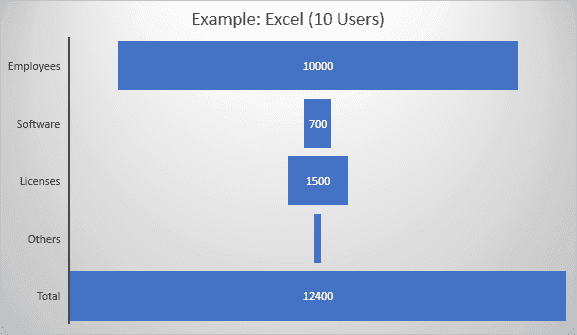 The numbers above are samples only.
EPM software compresses that work. Because data flows in from source systems and calculations run centrally, fewer people are needed for the same task, so even though the software itself carries a license cost, the drop in labor and licensing spend elsewhere brings the total down.
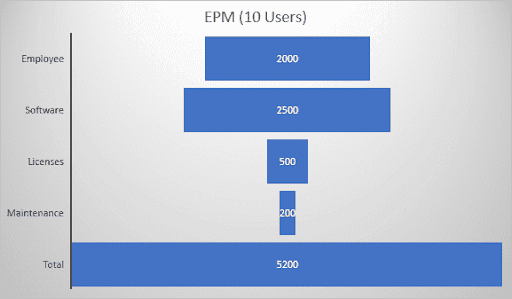 The numbers above are samples only.
The time spent producing recurring deliverables, a balance sheet or an expense report, for example, drops sharply, and automating the mechanical steps removes the rework that manual processes create, so the close runs faster and more predictably. The capacity that frees up can be redirected to higher-value work, which balances workloads and raises overall productivity.
Empowering Your Team
EPM applications provide a consistent, user-friendly interface with built-in calculations and functionality, so employees spend their time on analysis rather than on wrangling formulas and reconciling versions of a spreadsheet. Everyone works from the same numbers, which ends the familiar arguments over whose file is right and cuts the manual reconciliation that eats into a finance team's month. A steadier, less error-prone workflow is not just more efficient; it makes for a better day-to-day work environment and a more engaged team.
Growing the Business
EPM also gives leaders a clearer, more detailed view of the company's financial position. With reliable forecasting and budget planning, an organization can monitor spending and cash far more closely than a spreadsheet-based process allows, for instance, forecasting ending cash accurately enough to optimize the interest it earns on idle balances.
Beyond visibility, a connected EPM platform lets you model different scenarios quickly, testing how a new hire plan, a price change, or a shift in demand would flow through the financials, so leadership can make faster, more confident decisions instead of waiting on a rebuilt spreadsheet. Combined with the resources freed up elsewhere, that agility is what turns better reporting into real growth.
Put together, cost savings, a more productive team, and sharper financial visibility are what make EPM worth the move for a growing organization. If you would like to explore what an EPM solution could do for your company, the CloudADDIE team is glad to help.