

Oracle's Planning and Budgeting Cloud Service (PBCS) delivered the capabilities of Oracle Hyperion Planning (planning, budgeting, and forecasting) as a cloud service, and Oracle has since folded it into Oracle Fusion Cloud EPM, where planning and budgeting is delivered through the unified Planning business process.
The walkthrough below still holds for a straightforward, single-entity build: this is what the sequence typically looks like once scope is set. Larger or multi-entity implementations compress or extend the same steps rather than changing them, and our Product-Specific Scoping page covers how we size a project and set its timeline before work begins. For how that scoping and pricing works end to end, see "Implementing Oracle Fusion Cloud EPM Planning: Our Approach".
A LOOK AT OUR IMPLEMENTATION PROCESS
Week 1: Requirements Gathering and Initial Setup
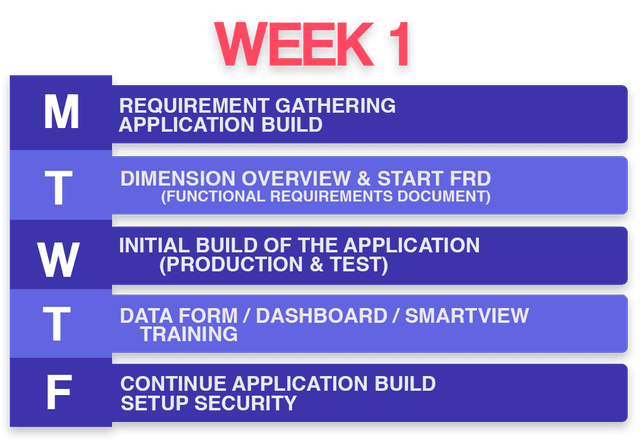
The first week of implementation focuses mainly on requirements gathering and initial application building. This is when our consultants discuss the design with subject matter experts (SMEs) and gather the information needed to shape the application.
We will also set up the application in the test and production environments that come with your subscription, and configure security settings and user access (so users can view the application and offer insight as we start building).
We keep end users engaged from week 1 all the way to go-live. This way, once training and user acceptance testing (UAT) begins, end users are already familiar with the application rather than caught off guard.
Week 2: Application Design and Metadata Loading
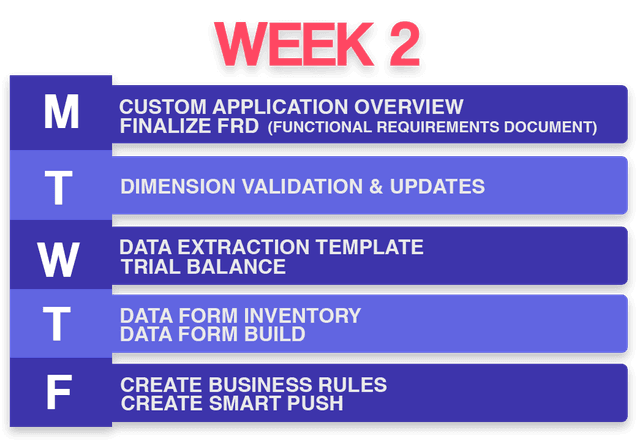
As we progress to the second week, our consultants design the application and begin loading metadata: the dimension hierarchies such as Account, Entity (your organizational structure, including cost centers and departments), and any custom dimensions your business requires. We also set up integrations to extract data from source systems (using Data Integration) so future data loads run smoothly.
Forms are created for manual data input, such as topside adjustments and planning and budgeting inputs. This week also starts the design of business rules, built in Calculation Manager, that run calculations based on your business processes.
Week 3: Business Rules and Data Loading
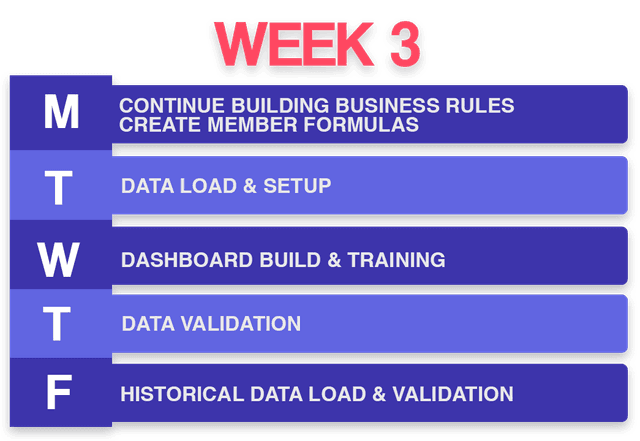
Week 3 is when we finalize business rules and start the data load process. Our consultants first load the current year's data, since it's easier to validate and to build reports and dashboards on. Once the current year has been validated, we load the historical data.
Final Week: Production Migration and User Testing
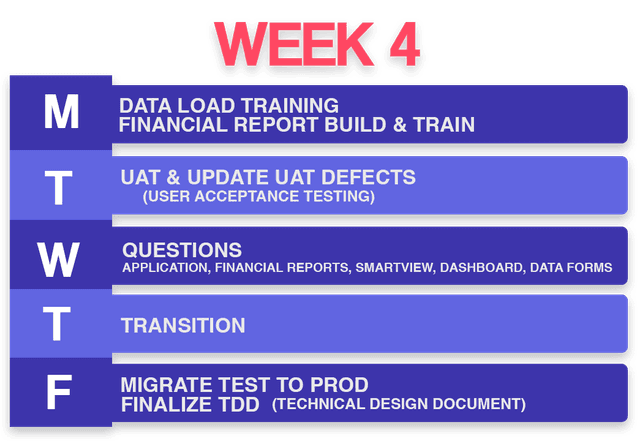
In the final week of the implementation process, our consultants migrate the application into the production environment. This is also the phase where we perform user testing.
Once user testing is complete, CloudADDIE provides further training through documentation and knowledge transfer sessions. We can also hold another Q&A if needed to answer any additional questions from users.
After the process is completed, CloudADDIE offers 30 days of support after production sign-off, so users can still reach out if any questions or issues arise. For ongoing support after that window, our Managed Governance offering covers application administration, enhancement backlog, and metadata and security governance on a month-to-month basis.