
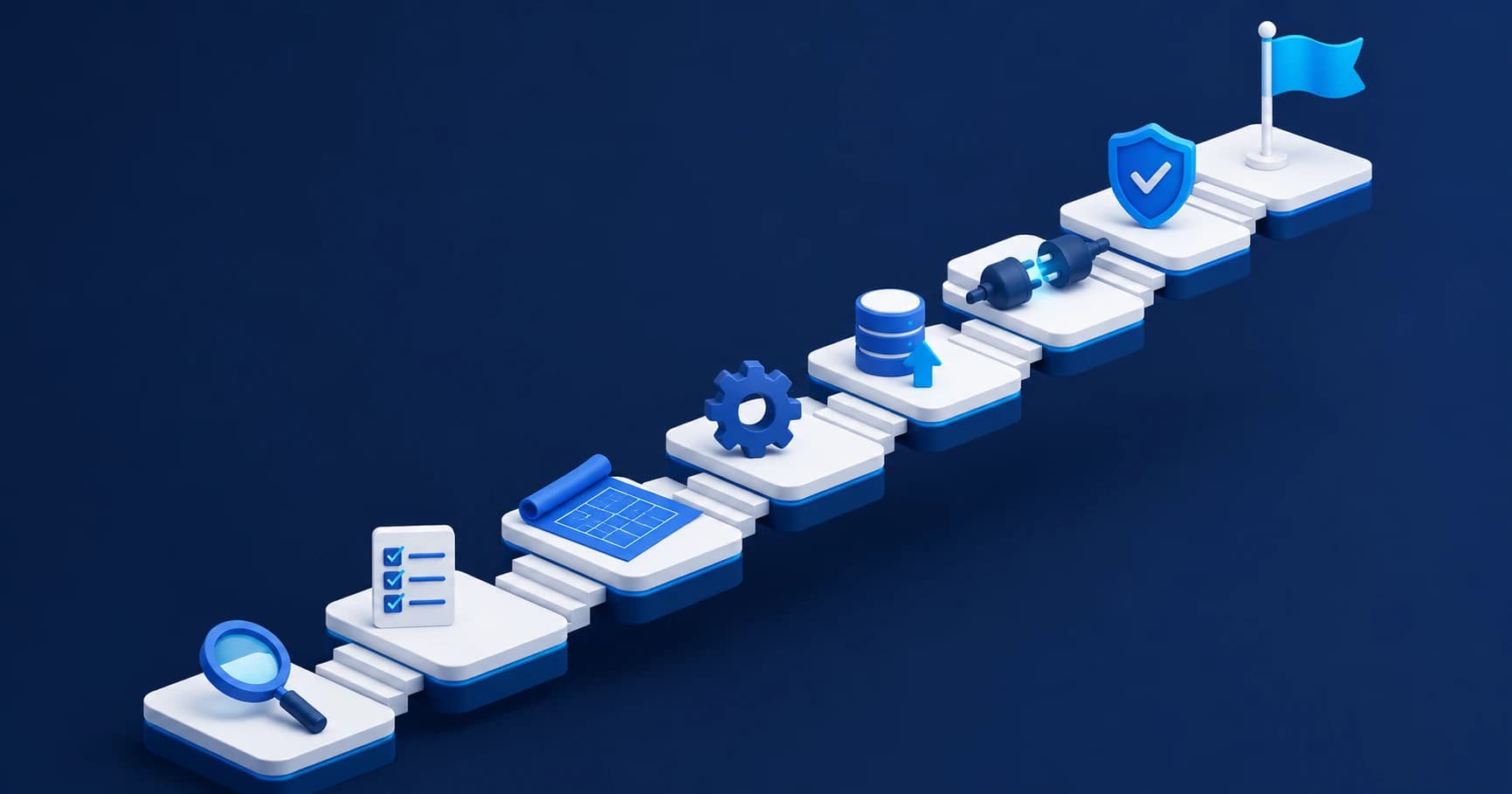
Every Oracle EPM Cloud project looks simple from a distance: pick a module, configure it, go live. In practice, a successful implementation moves through a defined sequence of phases, each with its own deliverables, stakeholders, and risks. Skipping or rushing any one of them tends to be where projects run into trouble months later.
This is Part 1 of a three-part series on the Oracle EPM Cloud implementation lifecycle. Here we walk through the phases that take a project from the first conversation to Go Live: Discovery, requirements, design, build, data migration, integration, and testing. Part 2 picks up after launch, and Part 3 covers extending your environment with additional planning modules.
Discovery: Understanding Before Configuring
Nothing gets configured during Discovery, and that is the point. This is where the implementation team sits down with business stakeholders to understand how finance actually works today: the reporting structures already in place, the pain points people live with, and what the organization expects the new system to do differently.
A thorough Discovery phase typically includes stakeholder interviews and workshops, a review of current financial processes and reporting, a clear picture of planning, consolidation, and forecasting needs, an inventory of where the new system will need to connect to ERP and other source systems, and documentation of key risks and assumptions. The output is not a spreadsheet of settings. It is a shared understanding of where the organization is starting from and where it wants to end up.
Writing the Business Requirements Document
Once Discovery wraps up, those findings get formalized into a Business Requirements Document, or BRD. A solid BRD captures the business objectives driving the project, how current processes compare to the future state, the specific functional requirements the system needs to meet, reporting expectations, and the data sources and dependencies involved.
The BRD gets reviewed and signed off by business stakeholders before design work begins. That approval step matters more than it might seem: a clearly defined BRD is what keeps scope disagreements from surfacing halfway through the build, when they are far more expensive to resolve.
Designing the Solution: FDD and TDD
With requirements locked in, the project moves into design, which usually produces two companion documents.
The Functional Design Document, or FDD, explains how the business requirements will actually be implemented inside Oracle EPM Cloud. It typically covers the planning and forecasting models, the metadata structure, workflow processes, approval hierarchies, calculation logic, and the security model.
The Technical Design Document, or TDD, covers the technical side: integration architecture, data flow diagrams, the data migration and conversion strategy, automation and scheduling, and system dependencies.
Together, the FDD and TDD become the blueprint the build phase works from.
Building the Application
This is where configuration actually happens, following the approved designs.
The Chart of Accounts gets established to align with financial reporting needs, defining account hierarchies, dimensions, and reporting rollups. Business Units, cost centers, entities, and departments are configured to mirror the company's real operating structure. And a role-based security model gets built out, typically spanning administrator roles, power users, finance planners, and read-only stakeholders, so governance and compliance are built in from day one instead of bolted on later.
Moving the Data: Migration and Conversion
Bringing historical and operational data into the new environment is its own milestone, and it really involves two distinct activities.
Data migration means moving historical financial data out of legacy systems and into Oracle EPM Cloud: historical actuals, budget data, forecast data, and metadata structures. Data conversion is what makes that legacy data usable once it arrives, through data mapping, cleansing and validation, and aligning everything to the new dimensional structure. Getting this right is what keeps reporting and analysis continuous instead of leaving a gap around the cutover.
Connecting to Source Systems
Finance systems rarely run in isolation, and Oracle EPM Cloud is no exception. Most implementations need to integrate with ERP platforms and other upstream or downstream systems, through ERP to EPM data loads, automated data extracts, scheduled refresh processes, and validation and reconciliation steps. Reliable integration pipelines are what make planning and reporting trustworthy day to day, not just on the day the system goes live.
Testing: SIT and UAT
Before anyone touches the system in production, it has to prove itself twice.
System Integration Testing, or SIT, is where the implementation team verifies end-to-end data flows, calculation logic, integration processes, and workflow functionality. This confirms the system works the way it was designed to.
User Acceptance Testing, or UAT, hands that verification to the actual business users. They validate the planning forms, reports and dashboards, forecast processes, and data accuracy they will be working with every day. UAT sign-off is what confirms the solution is genuinely ready for production, not just technically complete.
Cutover and Go-Live
The Cutover Plan is the checklist that governs the actual transition from legacy systems to Oracle EPM Cloud: final data loads, security activation, user provisioning, integration activation, and production validation. Once every item on that list is complete, the system moves to Go-Live, and the organization starts running its planning, close, or reporting process on the new platform for real.
What Comes Next
Go-Live is a milestone, not a finish line. Part 2 of this series covers what happens immediately afterward, including Hypercare, the Gold Tenant strategy, managing Change Requests, and the ongoing support model that keeps an EPM Cloud application healthy long after the project team moves on.