
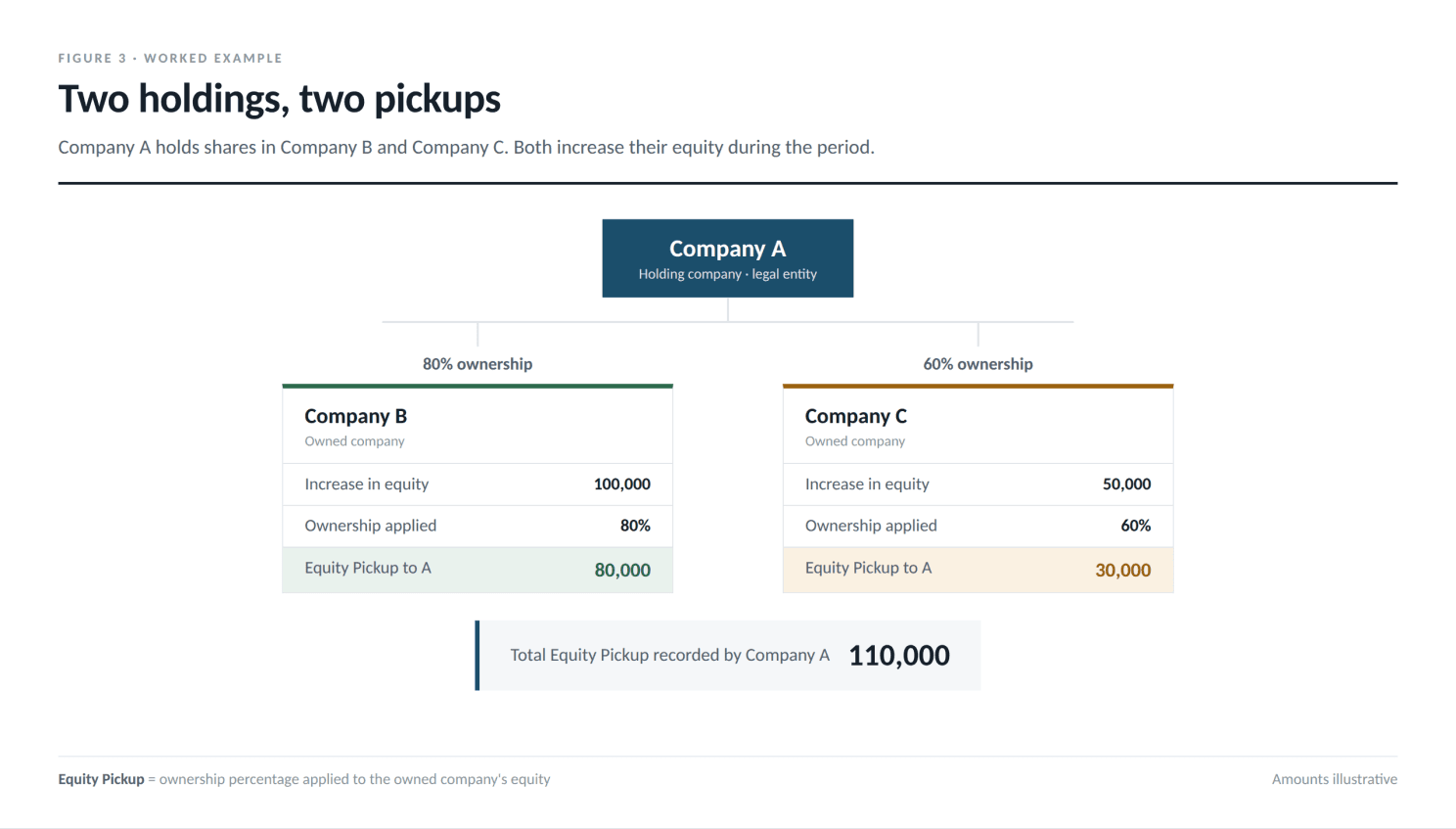
Equity Pickup in FCCS is used to update a company's investment value based on its ownership share in another entity.
FCCS calculates the pickup, records it in the holding company's own legal results, and later reverses it during group consolidation so that the same results are not counted twice.
It is worth being clear up front about what enabling the feature does and does not do.
Ownership Management has to be enabled first; it is a prerequisite.
The calculation itself runs through consolidation rulesets that an administrator configures and deploys, so switching the feature on does not by itself produce a pickup. And once enabled, the metadata Equity Pickup adds to the application cannot be removed.
How Equity Pickup Differs from the Equity Consolidation Method
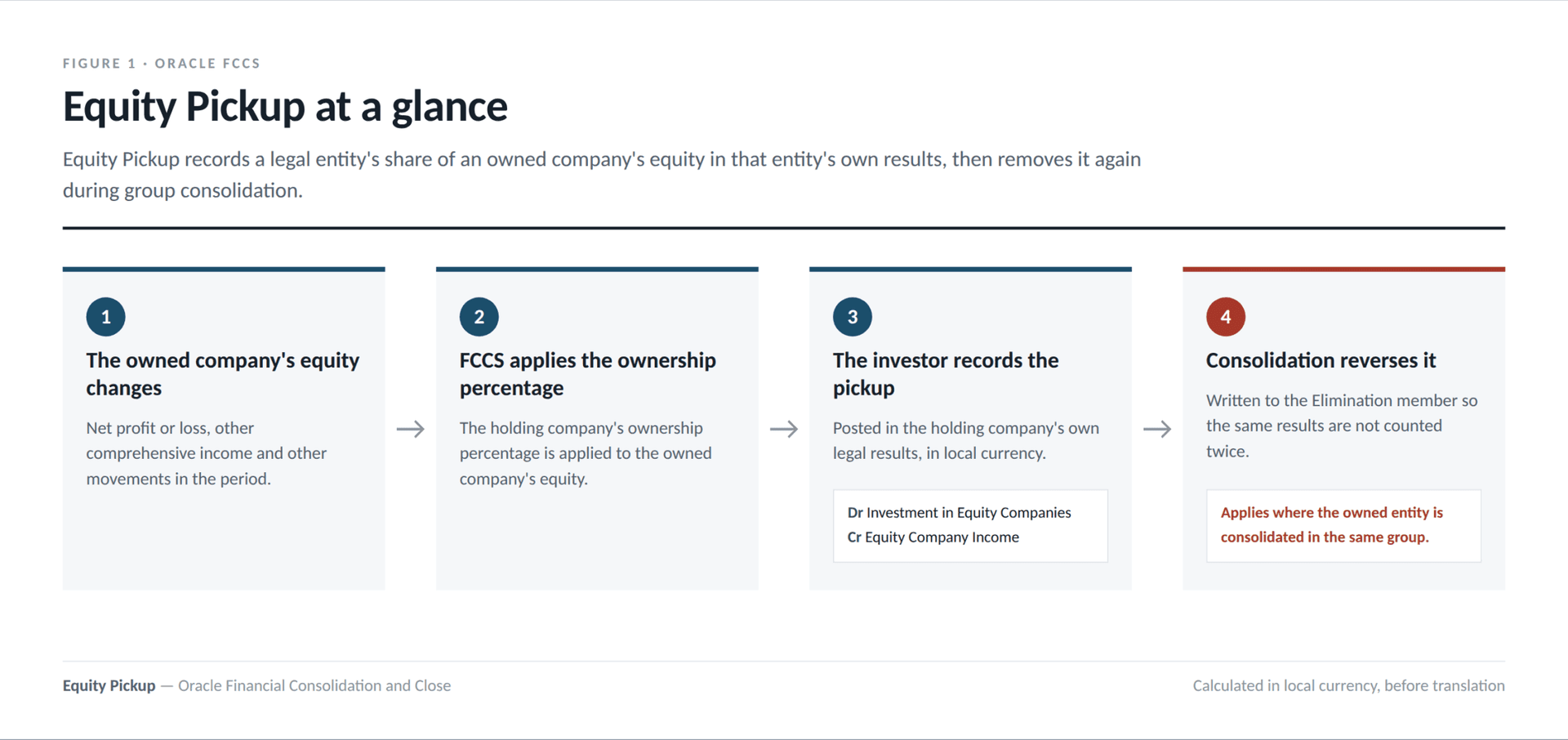
Both apply the equity method, but they answer different questions.
Equity Pickup is a legal entity calculation. Its purpose is to keep the investment value in the holding company's own books up to date, it applies to that company's individual records, and it is driven by local statutory reporting rules. So it is not required in every country. The amount is based on the holding company's ownership percentage in the owned company.
Whereas the Equity consolidation method belongs to consolidated reporting. It recognizes the investor's share of the results of an owned entity; it is applied according to IFRS or U.S. GAAP, and it is used where the investor has significant influence without control. In practice that means holding more than 20% and up to 50% of the voting shares; above 50% is control, and 20% or below is neither.
The two can apply to the same investee at the same time, for different purposes.
A Simple Example
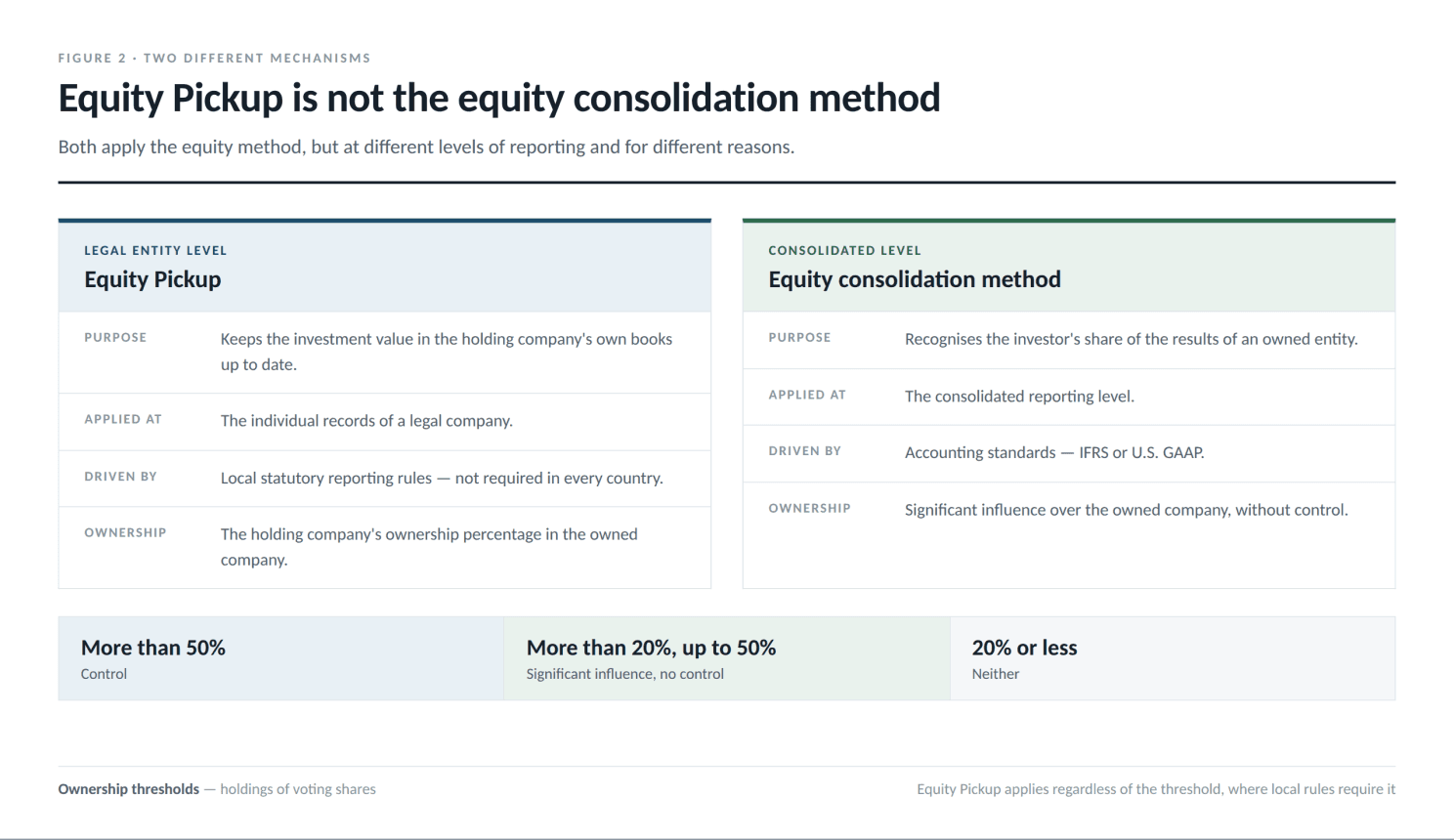
Company A owns 80% of Company B and 60% of Company C. During the period, Company B's equity increases by $100,000 and Company C's by $50,000.
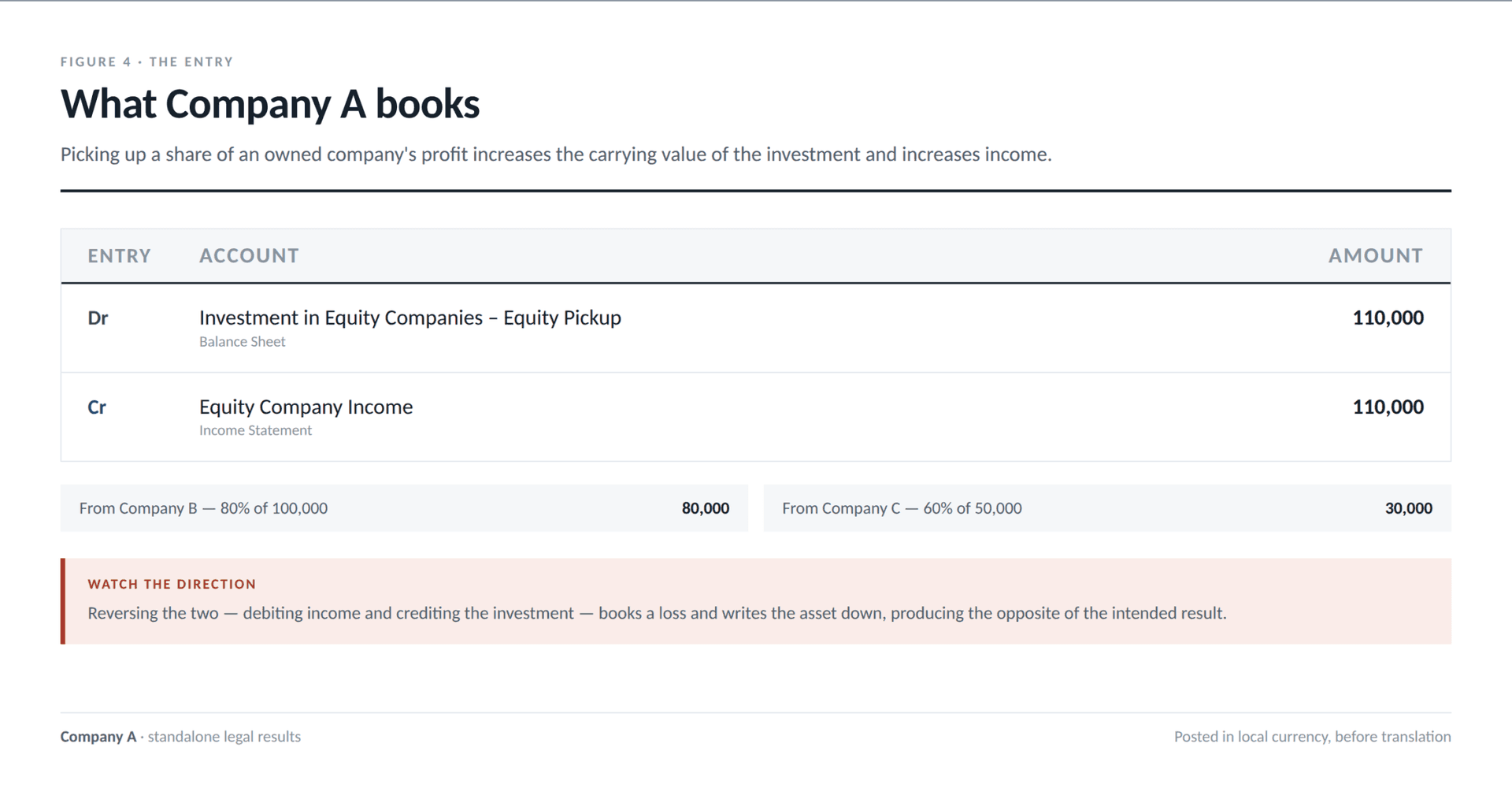
Applying each ownership percentage gives Company A a pickup of $80,000 from B and $30,000 from C, $110,000 in total.
Step 1: The Holding Company's Legal Results Are Updated
Company A's standalone results now reflect its share of the changes in B and C. The entry increases the investment and increases income:
Dr Investment in Equity Companies (Equity Pickup) 110,000
Cr Equity Company Income 110,000
The direction matters. Debiting income and crediting the investment does the opposite: it books a loss and writes the asset down.
Step 2: The Pickup Is Eliminated to Avoid Duplication
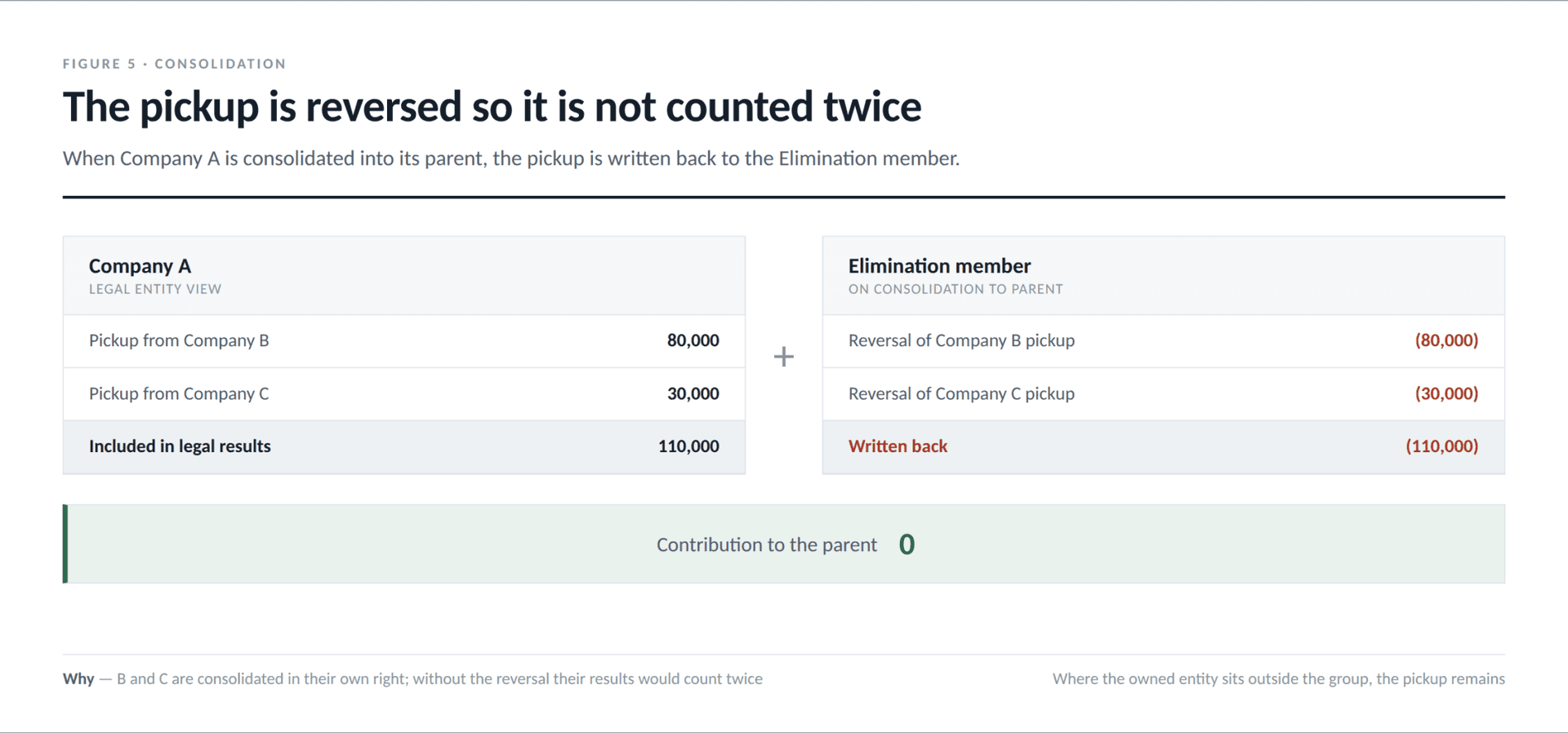
When Company A is consolidated into its parent, the pickup is written back to the Elimination member, bringing Company A's contribution for those accounts to zero.
The reason is straightforward. B and C are consolidated in their own right. If the pickup stayed in Company A, their results would be counted once through the pickup and again through consolidation.
This applies where the owned entity is consolidated in the same group. Where the investee sits outside the consolidation scope, the pickup is the intended outcome and should remain.
The Core Impact: A Change in the Consolidation Sequence
Enabling Equity Pickup changes how consolidation flows.
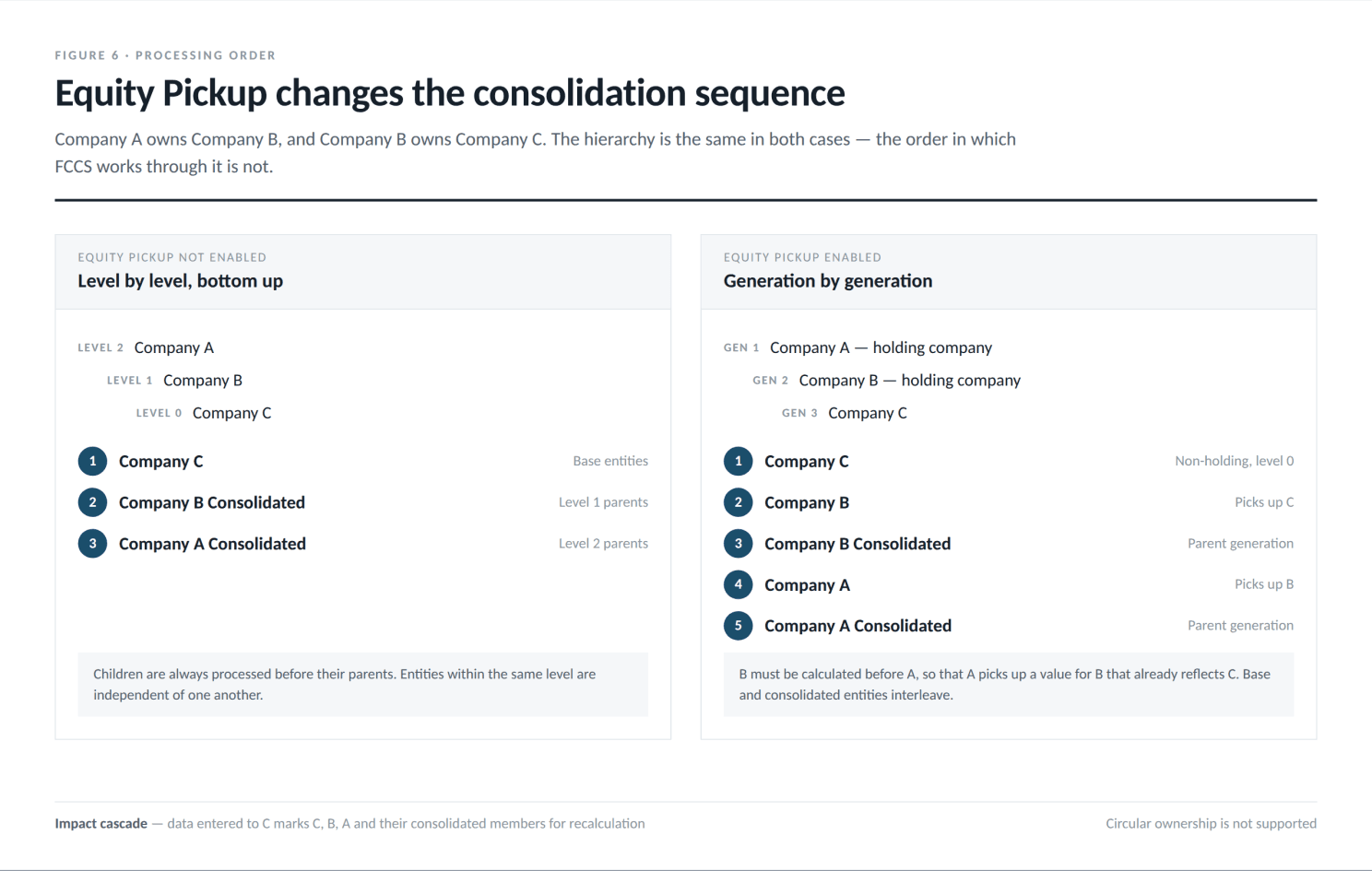
Without it, FCCS consolidates level by level, from the bottom up. Base entities first, then their parents, then the parents above those. Entities within the same level are independent of one another.
With Equity Pickup, FCCS reorganizes the sequence around generations rather than levels, alternating holding-company generations with parent generations from the bottom up.
Take a chain where Company A owns Company B and Company B owns Company C. The pickup for B has to be calculated before the pickup for A, so that A picks up a value for B that already reflects C.
The order runs C → B → B Consolidated → A → A Consolidated, so base and consolidated entities interleave.
The same dependency shows up in impact status: entering data to C marks C, B, A and their consolidated members for recalculation.
One limitation is worth knowing before design rather than after: circular ownership is not supported.
Key Points
- Legal reporting. Equity Pickup lets a legal company reflect its share of the change in value of its investments.
- Ownership based. The pickup applies the holding company's ownership percentage in the owned company.
- Direction of the entry. Debit the investment, credit Equity Company Income.
- Local currency. The calculation runs before translation.
- Elimination. Reversed into the Elimination member when consolidating into a parent where the owned entity is also consolidated.
- Processing order. FCCS sequences by generation, not simply by hierarchy level.
- Configuration. Enabling the feature is the start of the work, not the whole of it.
Overall, Equity Pickup adds a layer to the consolidation process: the system has to consider not only the entity hierarchy, but the ownership dependencies between entities.
And if you are scoping it, budget for the ruleset configuration rather than the enablement, confirm there are no cross-holdings in the ownership structure, and check that every legal company is flagged as an intercompany entity.
The consolidate rulesets identify the owned company through the Intercompany member, and one that is not flagged is skipped silently rather than raising an error.