
This is Part 1 of a three-part series on data warehousing. Part 2 opens up the architecture and data modeling; Part 3 covers the modern cloud data warehouse.
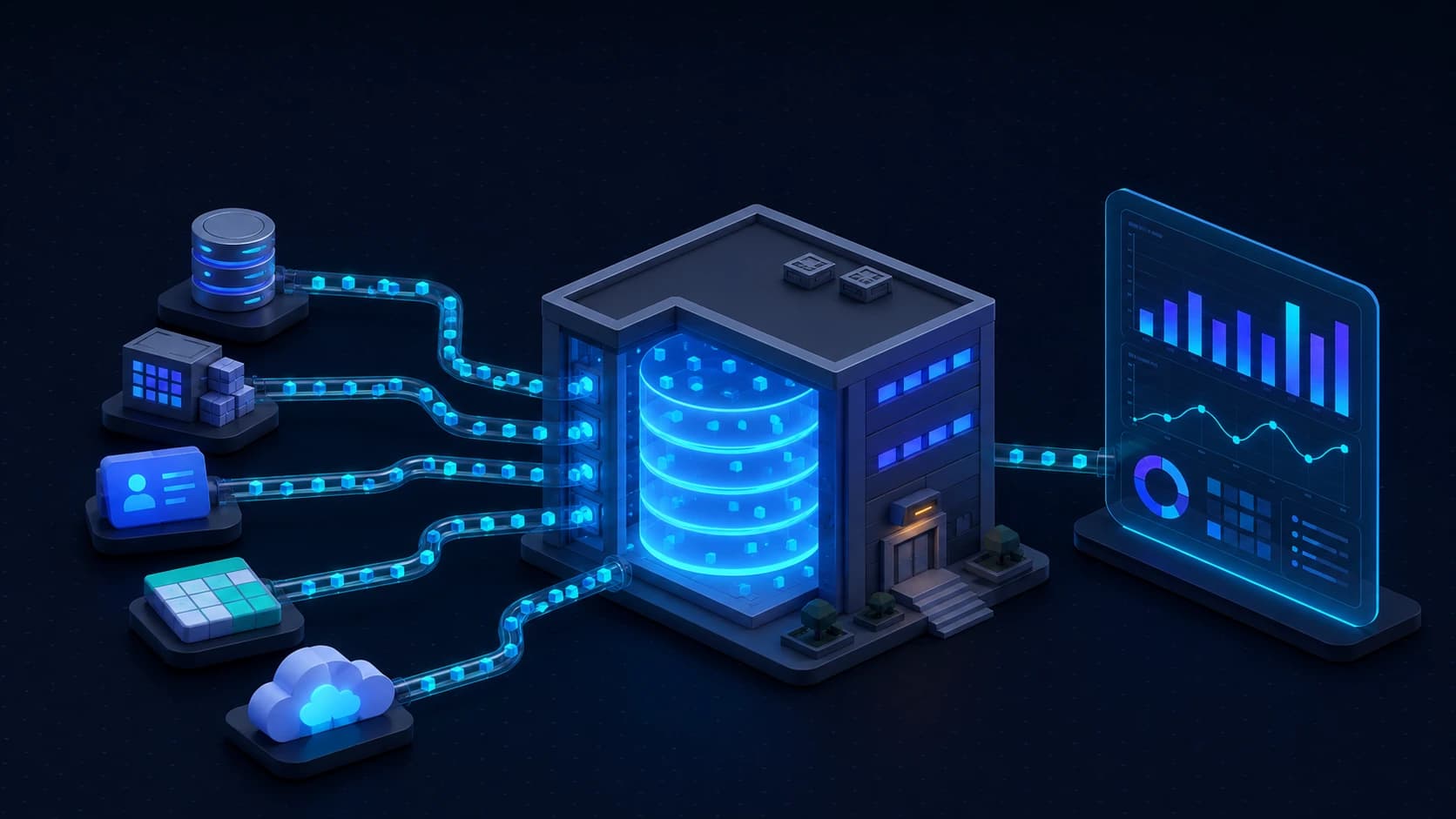
A data warehouse is a database built for one job: helping people analyze what is happening across an organization and make better decisions because of it. It pulls data together from many separate systems (the applications that run sales, finance, operations, marketing, and support), then cleans and reconciles that data and stores it in a form optimized for reporting, dashboards, and analysis rather than for running day-to-day transactions.
That last distinction is the heart of it. The systems that run a business (order entry, point of sale, billing, HR) are designed to record transactions quickly and accurately, one row at a time. Ask them to answer "how did margin trend by region over the last three years?" and they struggle, because they were never built for questions that sweep across millions of rows and multiple systems at once. A data warehouse exists precisely to answer those questions, and to do it without slowing down the operational systems that keep the business running.
Because it consolidates information from across the organization, a well-built warehouse becomes valuable in its own right: a single, trusted source of truth that analysts, executives, and, increasingly, the machine-learning models behind forecasting and personalization can all rely on. It is worth clearing up one common misconception right away: a warehouse does not only pull from SQL databases. It integrates data from applications, event streams, files, APIs, and third-party feeds, in structured and semi-structured formats alike.
The four characteristics that define a data warehouse
Decades ago, Bill Inmon, often called the father of the data warehouse, described four properties that still capture what makes a warehouse different from any other database. They are worth understanding because they explain nearly every design decision that follows.
Subject-oriented. A warehouse is organized around the major subjects of the business (customers, products, sales, shipments) rather than around the applications that happen to generate the data. You model the business, not the software.
Integrated. Data arrives from many systems that each have their own naming conventions, units of measure, encodings, and formats. The warehouse resolves those conflicts so that "customer" means the same thing everywhere. Integration is what turns a pile of disconnected extracts into a coherent whole.
Nonvolatile. Once data lands in the warehouse, it is not meant to be overwritten with every new transaction. New data is added; history is preserved. In practice, warehouses do apply corrections and track how attributes change over time, but the guiding principle holds: you don't destroy history, because the whole point is to analyze what has already happened.
Time-variant. A warehouse keeps a long horizon of history, often many years, so you can see how things change over time. Every record is, in effect, tied to a point in time, which is exactly what makes trend analysis, forecasting, and year-over-year comparison possible.
Data warehouse vs. transactional database
The clearest way to understand a warehouse is to set it beside the transactional systems it draws from. These are often called OLTP (online transaction processing) systems, and they are optimized for the opposite of what a warehouse needs.
| Transactional system (OLTP) | Data warehouse | |
|---|---|---|
| Purpose | Run the business: record transactions | Analyze the business: support decisions |
| Typical operation | Read or write a handful of rows ("get this customer's current order") | Scan thousands to millions of rows ("total sales by region last quarter") |
| Who updates it | End users, continuously, one transaction at a time | Data pipelines, in batches or streams; users query but rarely edit directly |
| Data modeling | Highly normalized, to keep writes fast and consistent | Often denormalized or dimensional, to keep analytical reads fast |
| History kept | Usually only what current operations need, weeks or months | Months to years, by design |
| Optimized for | Many small, predictable writes | Large, ad hoc, unpredictable reads |
Neither is "better." They are built for different jobs, and they depend on each other: the warehouse usually gets its raw material from exactly these transactional systems. Separating the two also protects the business: heavy analytical queries run against the warehouse instead of bogging down the systems taking live orders.
Warehouses, marts, and operational data stores
Three terms often get lumped together as "types of data warehouse," but they play distinct roles, and treating them as interchangeable leads to muddled designs.
Enterprise Data Warehouse (EDW). The centralized, organization-wide warehouse. It holds the consolidated data at the center of the architecture, in its most detailed (atomic) form, and provides a 360-degree view of the business through one consistent model. When people say "the data warehouse," this is usually what they mean.
Data mart. A subset of a warehouse focused on a single line of business: sales, finance, or marketing, for instance. It is smaller, faster to build, and easier for a specific team to work with. A dependent data mart draws its data from the central EDW, so definitions stay consistent across the company; an independent data mart is built directly from source systems, which is quicker to stand up but risks reintroducing the very inconsistencies a warehouse exists to eliminate. Marts can be physical copies of the data or simply logical views over the warehouse.
Operational Data Store (ODS). This is the term most often misunderstood. An ODS is a database that integrates current data from several operational systems and keeps it up to the minute, so the business can run near-real-time operational reports about what is happening right now. Crucially, an ODS is the opposite of the warehouse on two counts: it holds current rather than deep historical data, and it is volatile (records are overwritten as operations change) rather than nonvolatile. It is frequently used as a consolidation point that also feeds the warehouse downstream. An ODS complements a warehouse; it does not replace one, and it is not simply "the warehouse refreshed in real time."
Who needs a data warehouse?
A warehouse earns its keep when the questions a business needs to answer outgrow the systems it runs on. In practice, you likely need one when decisions depend on combining data that currently lives in separate systems; when reports take too long, disagree with one another, or bog down the operational systems they run against; when you need reliable history to spot trends, forecast, or satisfy reporting and compliance requirements; when non-technical people across the business need self-service access to consistent, trustworthy numbers; or when you want a clean, governed foundation for analytics and machine learning.
If teams are emailing spreadsheets back and forth and arguing about whose numbers are right, that is usually the clearest sign the moment has arrived.
The benefits, concretely
- A single source of truth. One consistent, reconciled version of the data everyone can point to, instead of competing spreadsheets and one-off extracts.
- Faster, better decisions. Analysts and leaders get answers in seconds rather than waiting on IT to assemble data by hand.
- Real historical depth. Years of consistent history make trends, seasonality, and forecasts possible in a way transactional systems never allow.
- Consistent, higher-quality data. Integration surfaces and resolves conflicts, standardizes definitions, and can even correct bad data on the way in.
- Analytical performance at scale. Columnar storage and parallel processing return results over enormous datasets quickly.
- Lighter load on operational systems. Analysis runs against the warehouse, leaving the systems that take orders and payments free to do their job.
- Democratized access. With a semantic layer and BI tools, people beyond the technical team can explore data safely and self-serve.
- A foundation for AI and advanced analytics. Clean, governed, historical data is exactly what machine-learning and forecasting models need.
- Lower long-run cost. Consolidating reporting and integration onto one platform reduces duplicated effort and one-off data plumbing over time.
Where data warehouses show up
Almost any organization that runs on more than one system and wants to understand itself over time eventually builds one. Banking and insurance use warehouses for risk, fraud detection, and regulatory reporting; retail and e-commerce for customer 360 views, inventory, and personalization; healthcare for outcomes, claims, and population analysis; airlines and logistics for operations and dynamic pricing; and manufacturing, telecom, and the public sector for everything from supply-chain visibility to service delivery. The industries differ, but the underlying need is the same: turn scattered operational data into a coherent picture of the whole.
Coming up next
That is the what and the why. But how does data actually get into a warehouse, and how should it be structured once it's there? In Part 2, Data Warehouse Architecture & Data Modeling, we open up the box: the pipeline that moves data in, and the two modeling philosophies that shape what's inside.