Global reconciliation processes often involve transactions from multiple currencies.
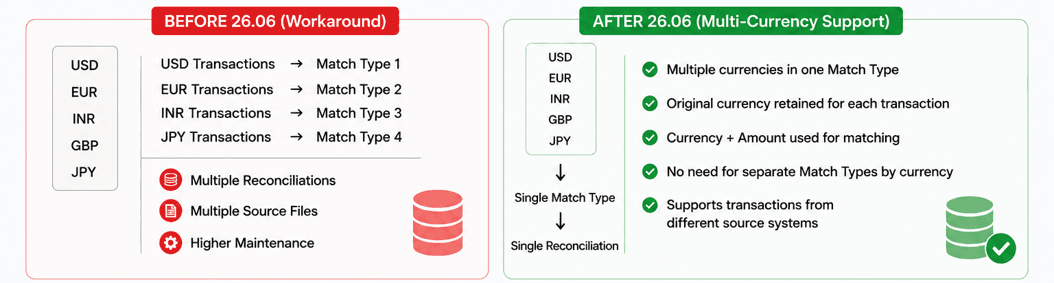
Before this enhancement, organizations with multi-currency matching requirements could design separate currency-based processes, such as splitting source files by currency, creating separate Match Types, or maintaining parallel reconciliations. The exact approach depended on the organization's configuration.
With the 26.06 update, Oracle Account Reconciliation introduces support for multiple currencies in Transaction Matching.
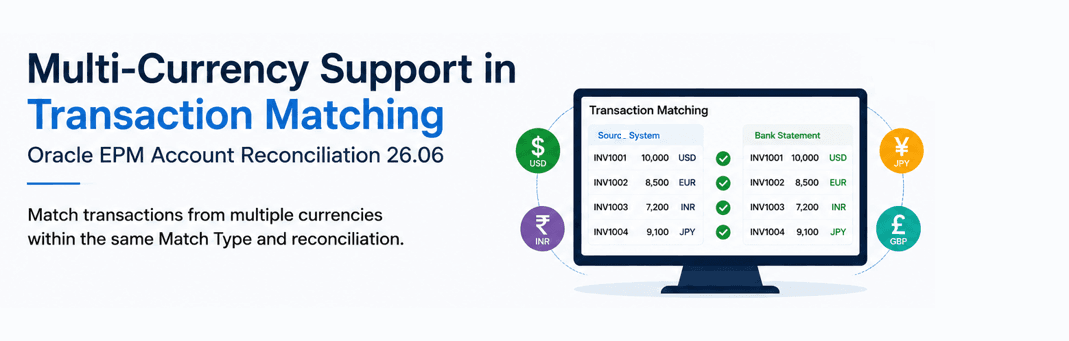
The core idea is simple: multiple currencies can be loaded and matched within the same Match Type, while each transaction retains its associated currency.
What Changed?
When defining a Match Type, Service Administrators can now enable multiple-currency support for a data source by selecting Currency for a Text attribute in the Data Sources tab.
This allows each transaction loaded to that data source to be associated with a currency such as USD, EUR, INR, JPY or GBP.
Multiple currencies can then coexist within the same Match Type.
How Does Matching Work?
Currency becomes part of the matching context.
When transactions are matched:
- The currency must match.
- The amount must match.
- The precision used for amount matching is based on the currency associated with the transaction.
For example, transactions in USD and EUR can exist within the same Match Type, but the currency itself is considered when determining whether transactions match.
Important Clarification
This is currency-aware matching.
It is not an FX conversion or currency translation feature. The enhancement does not mean that a USD transaction is converted into EUR for matching. The transaction's currency remains part of the matching process.
What Does This Change Operationally?
The enhancement can reduce the need for currency-specific workarounds.
Instead of designing separate processes solely because transactions use different currencies, organizations can support multiple currencies within the same Match Type.
Oracle specifically highlights benefits such as:
- Avoiding the need to split source files by currency
- Reducing the need to create separate Match Types per currency
- Reducing the need to maintain parallel reconciliations
- Supporting a single reconciliation for multiple currencies within the lowest configured currency bucket
The exact configuration and reconciliation behavior still depend on the currency buckets enabled for the profile.
Better Visibility of Currency Information
The currency code is also available in key areas of Transaction Matching, including:
- Transaction tab
- Drill-through links
- Transaction exports
- Balance reports
This improves visibility into the currency associated with transactions and supports downstream reporting.
The Business Impact
For organizations managing multi-currency reconciliation processes, the main value is a simpler matching design.
1. Simplified Configuration
Multiple currencies can be handled within the same Match Type instead of automatically requiring a separate currency-based Match Type.
2. Lower Operational Overhead
Organizations can reduce workarounds such as splitting source files by currency or maintaining parallel currency-specific reconciliation processes.
3. Better Currency Visibility
Users can see the currency associated with transactions across key Transaction Matching views and outputs.
4. Improved Reporting Transparency
Currency information is available in transaction exports, drill-through links, and balance reports, improving visibility for downstream reporting.

The Key Takeaway
The important change is not simply the ability to store multiple currency codes.
It is the ability to design a more streamlined Transaction Matching process where multiple currencies can coexist within the same Match Type, while the currency remains part of the matching context.