

Note: This article was first published in 2020 and updated in December 2025 for current product naming. EPBCS (Enterprise Planning and Budgeting Cloud Service) is now delivered as part of Oracle Fusion Cloud EPM Planning (Enterprise edition), where Strategic Modeling is one of the built-in frameworks.
Oracle Strategic Modeling in the Cloud
Long-range financial forecasting is difficult precisely because the future is uncertain, and the teams responsible for it need to test many versions of it quickly. Strategic Modeling, a framework within Oracle EPM Planning (formerly delivered as EPBCS), is built for exactly that. It is the cloud successor to Oracle Hyperion Strategic Finance (HSF), the on-premises product it replaces, re-engineered for full integration with the other financial applications in the cloud.
Its core advantage is that it lets Financial Planning and Analysis (FP&A) and risk teams forecast the three primary financial statements, profit and loss, balance sheet, and cash flow, as an integrated model, and then explore alternatives against them. Using either the web interface or Excel through Smart View, you can build what-if analyses and multiple scenarios to see how a decision, such as a new product, acquisition, investment, or project, flows through the financials. Once the initial model is set up, business users can run those scenarios and business cases on their own, without technical involvement, and Strategic Modeling integrates with the other Planning modules so that short-term budget and forecast data can feed the long-range model.
Core Capabilities
Strategic Modeling ships with a built-in, hierarchical chart of accounts and a set of financial modeling capabilities designed for strategic, multi-year planning:
- Scenario rollups and what-if analysis to simulate alternative strategies, develop contingent scenarios, and stress-test the model.
- Treasury and capital-structure management, including a Debt Scheduler for fixed or variable-rate instruments such as bonds and term loans, and funding options that help optimize the capital structure and lower financing costs.
- Cash flow and balance sheet forecasting to understand your projected cash position in future years and make capital-structure decisions that protect liquidity and support your credit profile.
- Consolidations that roll entities up following the rules for financial consolidation, including minority interest, equity, and cost methods of accounting for subsidiaries.
- Sensitivity and goal-seek analysis to evaluate how sensitive results are to key drivers and to solve for the performance level needed to hit a specific financial target.
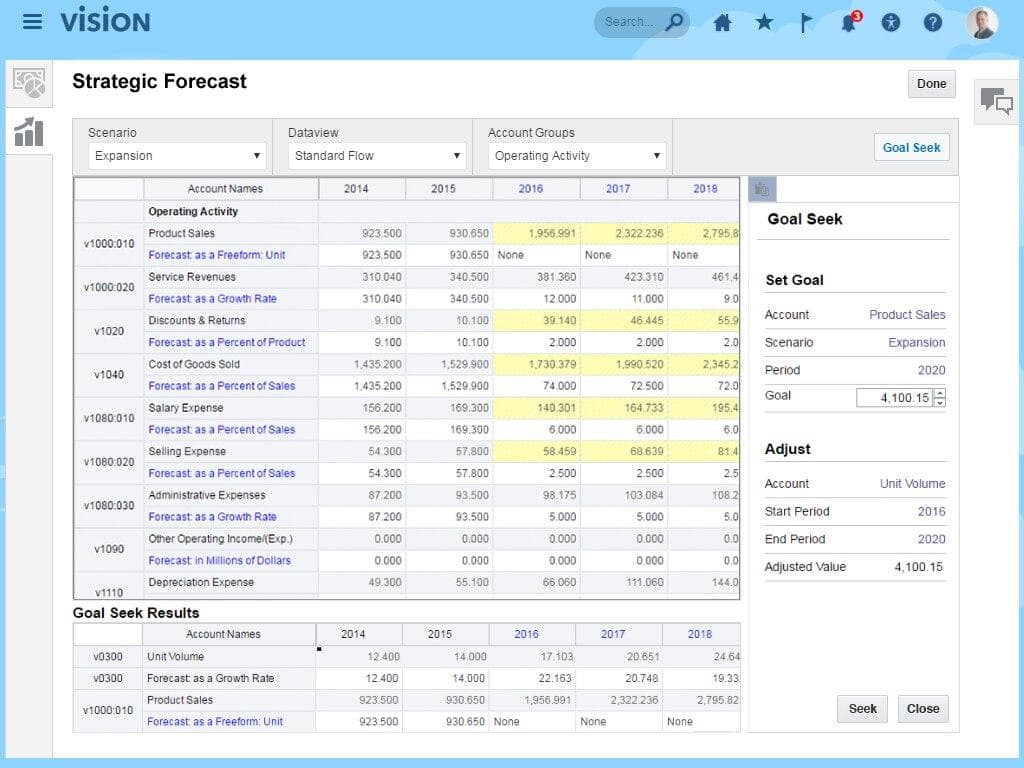
Taken together, these link the whole chain of financial performance, from earnings potential through working capital and capital expenditure to taxes and capital structure, in a single model that supports informed, board-level decisions.
Adapting the Model to Your Industry
Because Strategic Modeling is a flexible modeling environment rather than a fixed template, teams in specialized or regulated industries can extend it to their own reporting needs. An insurance FP&A or enterprise risk team, for example, can build models that translate GAAP forecasts to a statutory (STAT) basis and derive measures such as statutory surplus, risk-based capital, and total adjusted capital, along with the investment-income, interest-rate, and gains-and-losses assumptions those measures depend on. These are not out-of-the-box outputs; they are the kind of specialized analysis the platform's flexibility makes possible.
Strategic Modeling for Risk Management
Enterprise risk teams are often the biggest beneficiaries, because Strategic Modeling lets them build strategic business models around the specific pressures their business faces, whether that is the effect of an event on travel and hospitality demand, a supply shock, or a sharp shift in market conditions. Modeling those pressures against an integrated financial picture gives leaders insight into the potential impact and, just as importantly, into the levers available to mitigate it.
That is ultimately what makes the module valuable across the finance organization, from financial accountants up to the CFO: a shared, credible view of where to invest or divest as the economy shifts, and the agility to forecast for many possible futures rather than betting on one. CloudADDIE can work with you to implement Strategic Modeling and tailor it to the scenarios that matter most to your business.