
Most finance teams can tell you exactly how much revenue and expense hit the books last quarter.
Far fewer can tell you, with any real confidence, what it actually costs to serve a specific customer, product line, region, or business unit.
That gap between knowing your numbers and understanding your profitability is exactly the problem Oracle Enterprise Profitability and Cost Management (EPCM) was built to close.
It is a purpose-built modeling application inside Oracle's Enterprise Performance Management (EPM) Cloud suite. Its job is to take shared costs and revenue and allocate them across the parts of the business that actually generate them, in a way that is transparent enough for anyone to trace a number back to where it came from.
When Spreadsheets Stop Being Enough
Cost allocation almost never starts as a formal system. It starts with a spreadsheet. An analyst works out a set of percentages, gets sign-off from stakeholders, and spreads shared costs (IT, facilities, corporate overhead) across the departments or products that benefit from them.
For a while, this works fine.
Then the business changes. Product lines get added. Cost centers merge or split. Auditors start asking how a specific percentage was derived, and management wants to know why one region looks unprofitable while another does not.
The original spreadsheet, meanwhile, has grown into a web of nested formulas and manual overrides that only one person really understands.
None of this reflects badly on the finance team. It is simply what happens when a manual process gets asked to do a system's job.
Allocation logic that is not documented, versioned, or auditable becomes a liability the moment someone questions it, and in regulated industries, someone eventually will.
That is usually the point where organizations start looking at a dedicated allocation and profitability platform.
What Oracle EPCM Actually Is
Enterprise Profitability and Cost Management is an updated version of Oracle's profitability modeling tools, built for analysts who understand management reporting deeply but do not necessarily write scripts or code. A few capabilities define it.
- Point-and-click allocation modeling. Instead of hand-coded scripts, EPCM builds what Oracle calls waterfalls, sequenced chains of allocation and custom calculation rules that can run hundreds deep, applied consistently across periods or forecast ranges.
- Controlled calculation processes. You can run an entire model or just part of it, reverse a previous run if something looks off, and pull a complete calculation history for review.
- Broad integration. Models can pull dimensions and data from multiple financial and operational source systems, including Oracle ERP Cloud General Ledger and sub-ledger balances, into what Oracle calls a common functional allocation hub. If you also run Oracle Planning or Project Management, one thing to know: EPCM integrates with other Cloud EPM processes and ERP Cloud, but not directly with EPM Planning, Projects, or Fusion Project Management.
- Full transparency. Every run produces an audit trail: rule-by-rule results, performance statistics, and the ability to trace any allocated value back to its source.
EPCM is positioned as business-owned rather than IT-owned. Once a model exists, finance and operations teams can change drivers, assumptions, and allocation methods themselves, without waiting on a developer to rebuild anything.
Two Questions Every Allocation Model Has to Answer
Talk to anyone who has actually built allocation models, in EPCM or elsewhere, and a pattern shows up fast.
The hard part is rarely the software. It is answering two questions correctly.
Who should receive this cost? Not every cost belongs everywhere. A shared support function might only serve certain products; a specialized operations team might only touch specific customer segments. Get this eligibility question wrong, and cost spreads to places that never consumed the underlying service.
How much should each recipient receive? Once eligibility is settled, you need a fair basis for splitting the cost: a driver. Revenue, headcount, transaction counts, service consumption, and membership percentages are common choices. The right one depends entirely on what actually drives consumption of the thing being allocated.
In EPCM, this typically plays out in three parts.
Costs from multiple sources get consolidated into a single pool for transparency and easier reconciliation.
Eligibility is enforced using attributes tagged on dimension members, so only qualifying products, customers, or business units are considered.
Then the pool is split using driver-based percentages calculated from an operational metric.
Separating who from how much this way, rather than solving both at once, is what makes a model easy to explain, maintain, and defend in an audit.
Where Organizations Put EPCM to Work
Because the eligibility-plus-driver pattern is so general, EPCM shows up across a wide range of use cases.
Shared services costing and IT chargeback is probably the most common: allocating centralized IT, HR, or facilities costs to the business units that actually consume them, so those costs stop being invisible line items and start being numbers someone can defend.
Tax transfer pricing is another, automating intercompany allocations between legal entities while keeping a built-in audit trail for compliance.
In regulated industries like insurance, utilities, and telecommunications, similar modeling logic gets used for rate cases and regulatory filings, calculating and documenting costs that hold up under scrutiny.
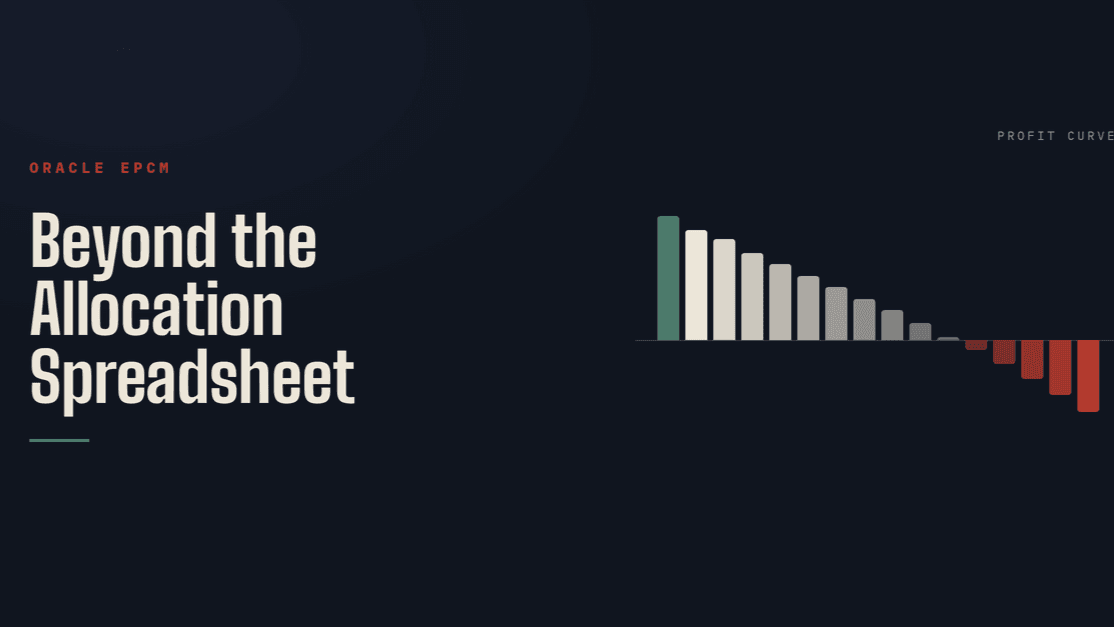
And then there is the classic use case, customer, product, and channel profitability, often visualized through a profit curve report that ranks segments from most to least profitable so leadership can see at a glance where margin is being made or lost.
The dimensions and drivers change from one use case to the next, but the underlying modeling logic of pools, eligibility, and drivers stays remarkably consistent. That is a big part of why one platform can handle all of them.
How Implementations Typically Take Shape
- Design the application. Settle on dimensions, attribute dimensions, naming conventions, and calendar and currency structure before building anything.
- Build out dimensions and cubes. Load metadata, then layer on member formulas, attributes, user-defined attributes, and smart lists.
- Build the rule sets. Construct the allocation and custom calculation rules that form the model's waterfall, tied to a defined point of view.
- Build dashboards and reports. Including the profit curves and allocation traces unique to profitability modeling.
- Customize navigation and security. Tailor access by role, from Service Administrators managing the application down to Viewers who only need to consume reports.
What is easy to miss in that sequence is that steps 1 and 2 matter more than steps 3 through 5. That point is worth its own read: dimensional design is the most expensive decision in an EPCM implementation.
Practitioners who write publicly about EPCM implementations tend to make the same point: the technical configuration goes quickly once the business has agreed on what a cost represents, who benefits from it, and which driver genuinely reflects consumption.
Skip that agreement, and you get a model that is technically correct and practically useless.
The Real Payoff Is Trust, Not Just Automation
It is tempting to think of EPCM as just a faster spreadsheet, and in a functional sense, that is part of what it is.
But the more durable value shows up elsewhere: in an allocation model that survives an audit, that a new analyst can understand without a handoff call, and that business owners can adjust themselves when a product line changes or a new region comes online, instead of waiting for someone to rebuild a formula chain from scratch.
Allocation stops being a periodic, manual chore and becomes a standing, trustworthy part of how the business understands itself. A spreadsheet can tell you what you spent.
EPCM is built to answer the harder question: what did it actually cost to earn what you earned, and can you prove it?