

Note: This tutorial was first published in 2020 and updated in March 2026 for current product naming and registration options. Oracle Enterprise Data Management Cloud Service (EDMCS) is now delivered as Oracle Fusion Cloud Enterprise Data Management (EDM), and Financial Consolidation and Close Cloud Service is now Oracle Fusion Cloud EPM Financial Consolidation and Close (FCCS). The registration flow is unchanged; a few configuration options have expanded, and those are noted below. Because Oracle refreshes the interface periodically, your screens may differ slightly from the screenshots.
This is a step-by-step tutorial on registering an application in Oracle Enterprise Data Management using the Financial Consolidation and Close application type. Registering an FCCS application lets you govern its chart-of-accounts and other master data centrally in EDM, then export changes back to FCCS. Before you begin, make sure you have an EDM role that permits application registration and the connection details (instance URL and credentials) for the FCCS environment you want to connect to.
One thing worth knowing up front: when you complete the registration, EDM automatically builds a governed data chain for the application. It creates the application with its settings, one default view, and, for every dimension you register, a dimension, a node type, a hierarchy set, a node set, and a viewpoint. That is what gives you a ready-to-use place to maintain each dimension once registration finishes.
For other EDMCS tutorials, check out "Importing Oracle Financials Cloud General Ledger Dimensions in EDMCS" and "EDMCS Alternate Hierarchy".
Step 1
Navigate to the Applications view and click Register in the top right.

Step 2
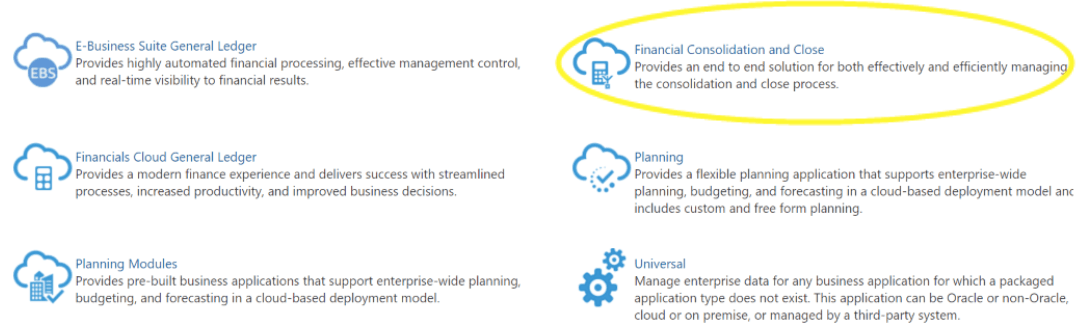
From the application type menu, select Financial Consolidation and Close and give the application a name. In this example it is named "FCCS1." A description is optional.

Step 3
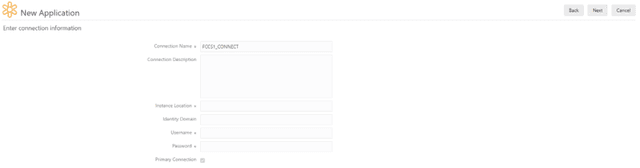
Add the connection to your external FCCS system. Name the connection, then enter the Instance Location URL, Identity Domain, username, and password for the external environment. Check Primary Connection if this is the main connection for the application.
Step 4
Once the connection is added, select Next to review it. If everything is correct, select Create.
Step 5
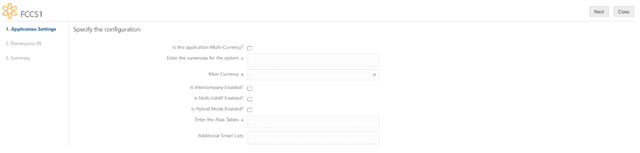
Enter the configuration settings for the application so they mirror your FCCS environment, then select Next to continue.
These settings have grown over time, so enter the ones that match your FCCS application. Beyond enabling Multi-Currency (where you also provide the currency codes and the main currency), you can indicate whether the application is Intercompany Enabled or Multi-GAAP Enabled, whether it runs in Hybrid Mode, and whether it is an Extended Dimensionality application (which allows up to four custom dimensions instead of two). You can also enable additional consolidation cubes (Consol2 through Consol5). Alias Tables will be "Default" unless additional alias tables have been created in FCCS.
Step 6
In this section you add the dimensions from your external FCCS environment.

Select Add to begin adding a dimension, then select Next to continue.
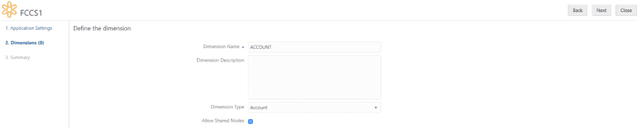
For each dimension, enter a name and optional description and choose a Dimension Type: Account, Entity, Movement, or Custom. Any dimension that is not Account, Entity, or Movement uses the Custom type.
For each dimension you can also choose whether to allow shared nodes. Custom dimensions additionally require an external dimension name and let you select which cubes they are valid for. If you need to, you can attach attributes to Entity, Movement, and Custom dimensions on the next step, whether simple attributes, attribute dimensions, or references to other registered dimensions.
Step 7
Review the summary of your application and make sure every field is correct. To complete the registration, select Apply.
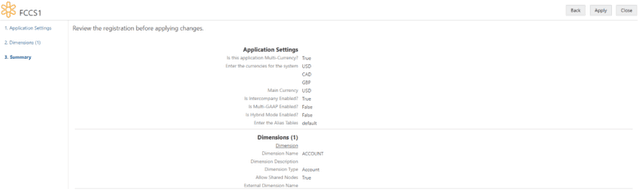
When you apply, EDM builds the data chain for each dimension and sets the objects to active, ready for you to import members. A confirmation message appears once the application has been created.
After the application exists, you populate it by importing dimension members, either from a CSV file or from the export file (.zip) produced by your FCCS environment. Keep in mind that predefined members come from that import: in EDM you can move, reorder, and add children under them and edit their unbound properties, but you cannot otherwise change them.
You can modify the application after creation from the Applications view: click the three dots under Actions and select Modify Registration.

From Modify Registration you can add or remove dimensions, change the connection information, or update other application settings such as the multi-currency option.
Want to learn more about EDMCS? Check out our EDMCS Overview.