
If you administer Oracle EPM Cloud, the Groovy engine behind your business rules has already been overhauled. Oracle first signaled this change for late 2025, moved it a few times, began the rollout with the 26.01 (January 2026) update, and ultimately made the new engine, commonly referred to as Groovy 2.0, the default in the 26.05 (May 2026) update. If you haven't validated your custom Groovy yet, this is still the most important housekeeping item on your list, because the stricter engine is now the default.
Translation of what changed: loose typing is gone, def no longer flies, and anything that leaned on the old engine's forgiving behavior (including some DataGrid Builder patterns) may now fail. Here's how to get, and stay, compliant.
The Groovy Script Validator: Your First Stop
Before touching any code, use Oracle's Groovy Script Validator, which has been available since the 25.08 update. Think of it as the gatekeeper: it flags non-compliant scripts before they break in production and tells you exactly where.
You can reach it from:
Overview → Actions → Groovy Script Validator
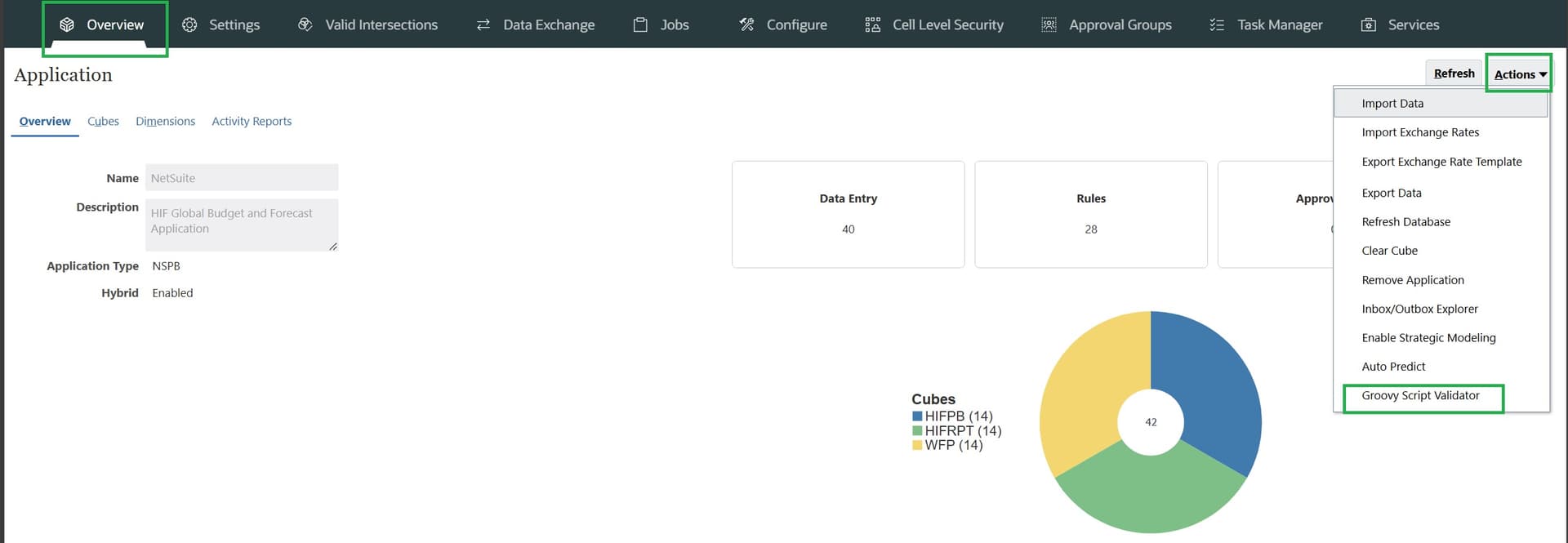
After you run it, open the validation report from Inbox / Job details to see the column where each error occurs and the associated error message.
What It Checks
- Static typing
- Method signatures
- Variable declarations
- Anything that worked loosely on the old engine and is now rejected
Process: Validate → fix errors → re-validate → test.
What Actually Breaks
Expect these on repeat:
- Static typing is now mandatory,
defis dead; declare real types. - DataGrid operations require explicit types,
getData()returns an object that must be cast. - Explicit casting for RTP values, otherwise cross-dimensional calcs fail.
- Null handling is no longer automatic, DataCell operations and cross-dimensional references need explicit null checks.
- Object wrappers break calculations,
setData()expects primitives (double, notDouble). - Iterators need explicit typing, use
Iterator<DataCell>, notdef, across all collection loops.
Oracle publishes a full error reference, but this handful of breaking changes drives the large majority of validation failures.
What Oracle Handled for You (and What It Didn't)
Oracle auto-remediated out-of-box module rules as part of the rollout (starting with the 26.01 update), so delivered content was updated for you. Custom Groovy rules are your responsibility, they must be validated and fixed manually. If you needed breathing room during the transition, the engine update could be deferred for up to three months using the EPM Automate skipUpdate command, but that grace period has now closed for most environments.